Learn
The real mechanics of astrology, explained the way they should have been explained to you the first time. Click any topic to expand.
The Chart Itself
Anatomy of a birth chart
↓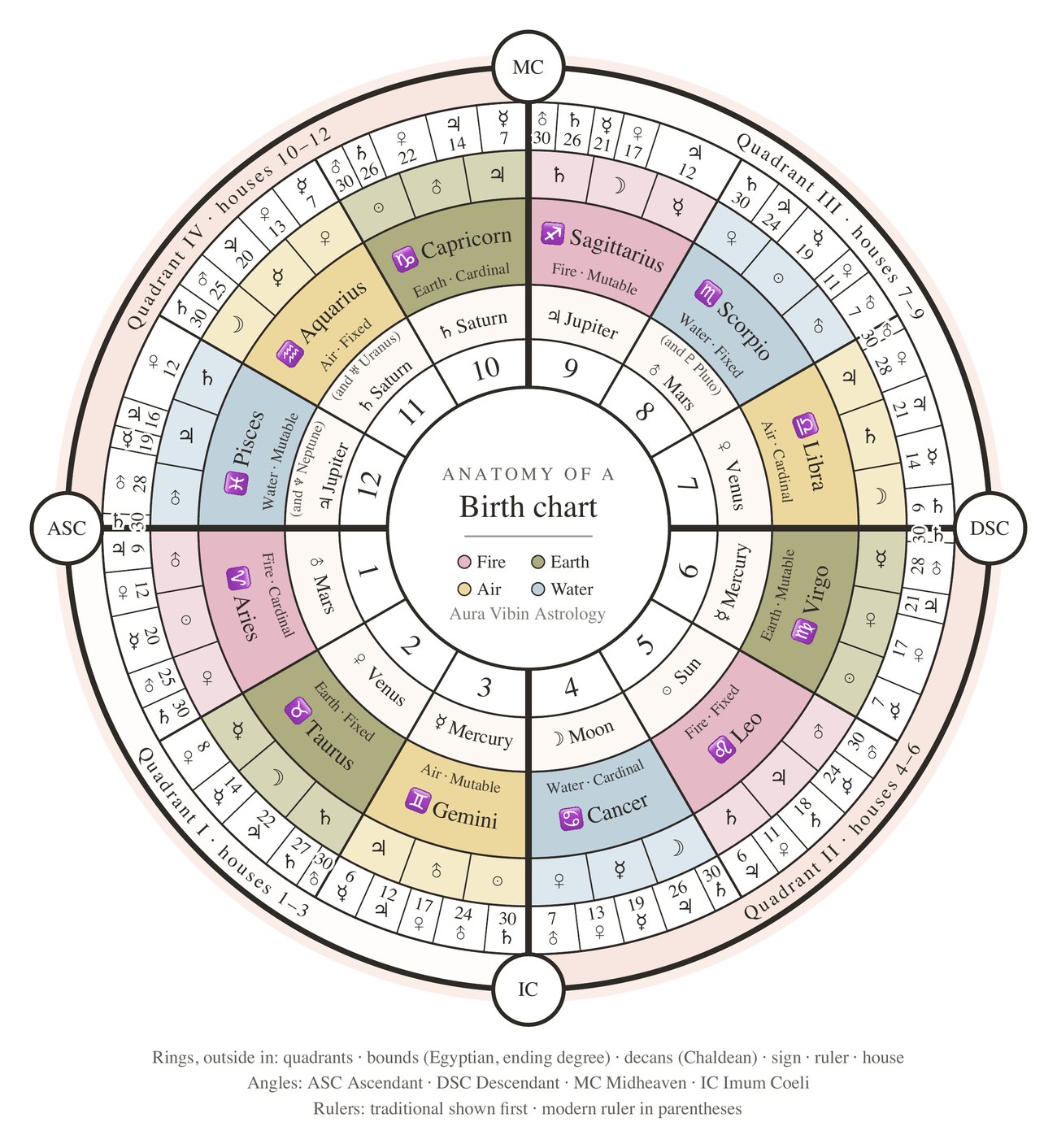
The meridian — the vertical gold line. Top is the Midheaven (MC): career, reputation, public life. Bottom is the IC: home, roots, the private foundation.
The four angles — ASC, IC, DSC, MC. The pillars. Planets near them are dramatically amplified.
Quadrants — the two axes create four quarters, each with a developmental theme: self-development (houses 1–3), grounding and expression (4–6), relationship (7–9), and contribution to the world (10–12).
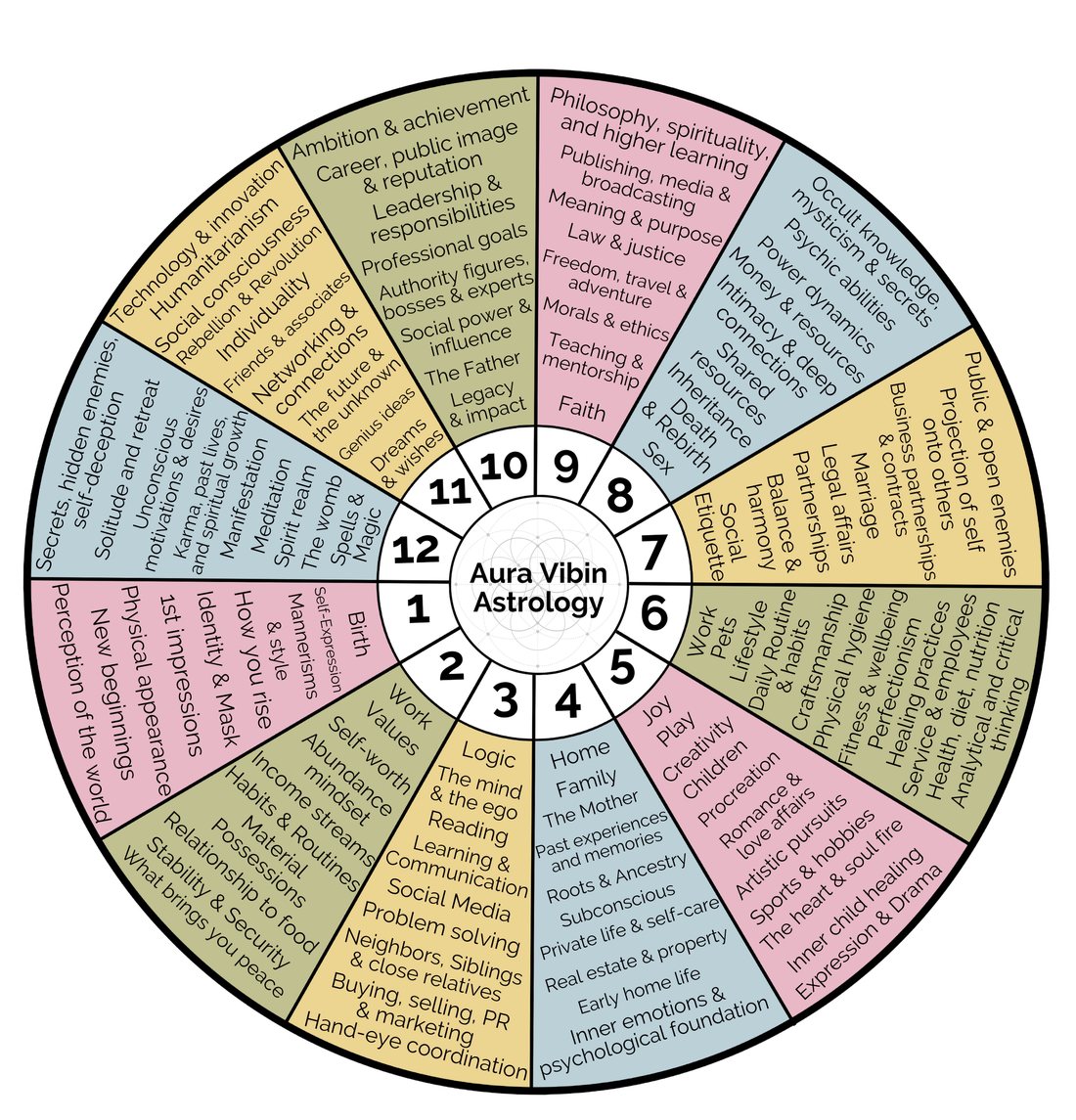
Houses — the twelve slices, numbered counterclockwise from the ASC. Each governs an area of life: 1 self, 2 money and resources, 3 communication and siblings, 4 home, 5 creativity and romance, 6 health and daily work, 7 partnership, 8 shared resources and transformation, 9 belief and travel, 10 career, 11 community, 12 the hidden and the unconscious.
Degrees — the circle is 360°, each sign holds 30°. A planet's exact degree determines its aspects and dignity. Each degree divides into 60 minutes of arc, each minute into 60 seconds — written 14°32'18".
Decans — each sign divides into three 10° faces, each with its own planetary sub-ruler. Two people with the same Sun sign but different decans carry a different flavor of it.
Sect — whether the Sun sits above the horizon (a day chart) or below it (a night chart). One of the oldest and fastest ways to judge how the planets in a chart will behave — covered fully in the Traditional Technique section.
The houses
↓
Hemispheres — north, south, east & west
↓Top half — houses 7, 8, 9, 10, 11, 12 — the SOUTHERN hemisphere. Yes, southern on top. The chart is drawn facing south, so the southern sky — where the Sun and planets ride — is the upper half. This was the visible sky at birth: the public, objective, outer-world half. Planets here push the life toward career, others, and the collective.
Bottom half — houses 1, 2, 3, 4, 5, 6 — the NORTHERN hemisphere. The sky beneath the earth at birth: the private, subjective, inner-world half. Planets here root the life in self, home, body, and daily ground.
Eastern half — houses 10, 11, 12, 1, 2, 3 — the ASC side (left). The rising half, where planets are climbing toward the Ascendant. Self-determined and initiating: "I shape my circumstances." A heavily eastern chart belongs to someone who moves first and creates their own conditions — independence is the default setting, sometimes to the point of struggling to receive.
Western half — houses 4, 5, 6, 7, 8, 9 — the DSC side (right). The setting half, where planets descend toward the Descendant. Relational and responsive: "my circumstances arrive through others." A heavily western chart belongs to someone whose life genuinely unfolds through partnerships, timing, and other people — collaboration is native, and forcing things alone rarely works.
Count the planets in each half before reading anything else. Nine planets above the horizon is a public life whether the person wants one or not.
Why the wheel runs counterclockwise
↓Motion 1 — the apparent daily sweep (clockwise on the chart). Earth itself spins counterclockwise — eastward, viewed from above the North Pole. Because we ride the spinning Earth eastward, the sky appears to sweep the opposite way: everything rises at the Ascendant, arcs over the Midheaven, and sets at the Descendant. On the wheel that apparent sweep runs clockwise. A planet that rose an hour ago now sits in the 12th house — carried up and over by the sweep.
The four quadrants
↓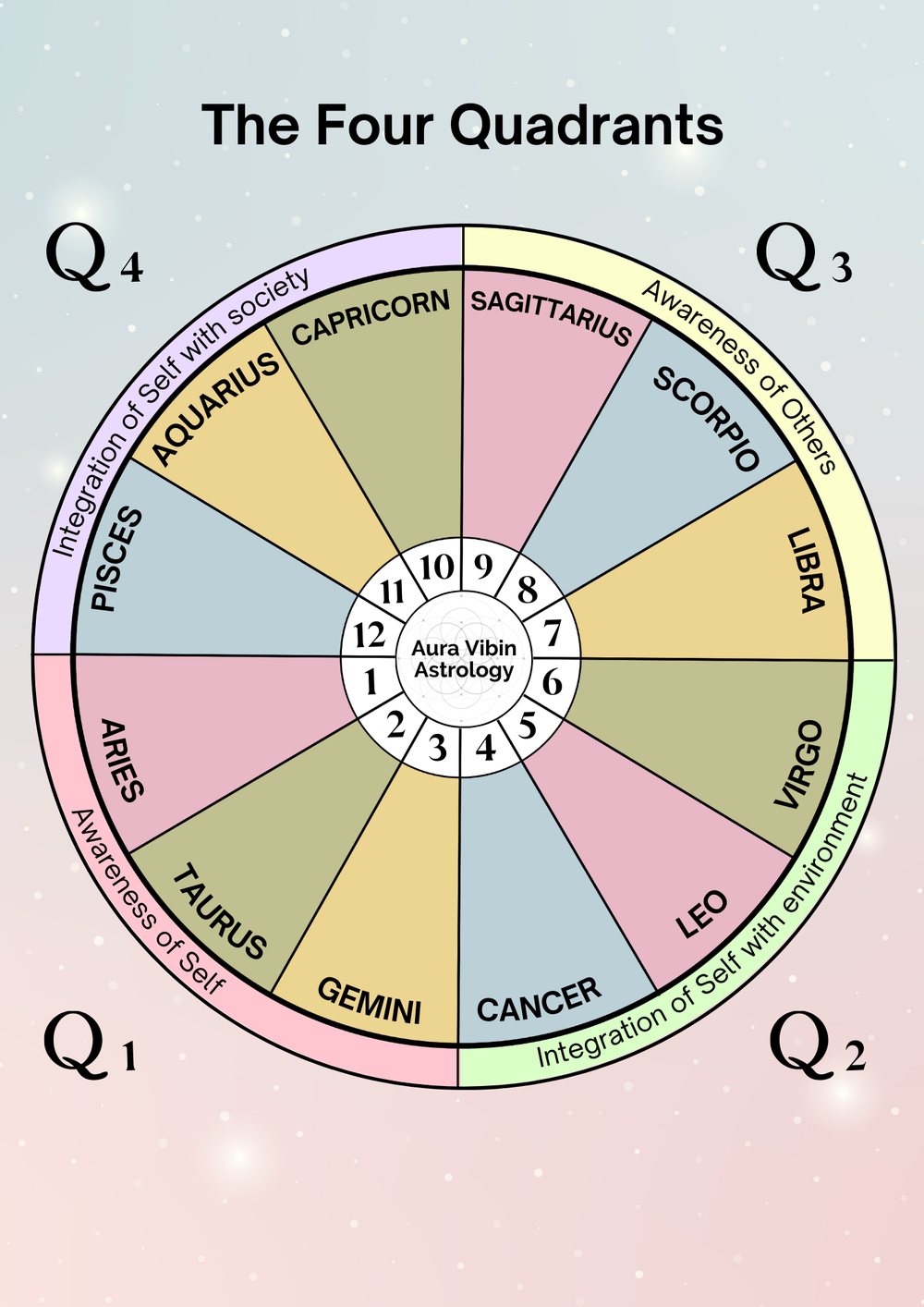 Quadrant 1 — houses 1, 2, 3 — Awareness of Self. Birth, body, resources, voice. The soul learning that it exists and what it has to work with. Planets here turn the life inward toward self-definition.
Quadrant 2 — houses 4, 5, 6 — Integration of Self with Environment. Home, creativity, daily practice. Taking that self and rooting it into the immediate world — family, expression, routine, the body's rhythms.
Quadrant 3 — houses 7, 8, 9 — Awareness of Others. Partnership, intimacy, belief. The self meets what it is not — other people, shared resources, foreign worlds — and is transformed by the encounter.
Quadrant 4 — houses 10, 11, 12 — Integration of Self with Society. Career, community, transcendence. The matured self gives its work back to the collective, then dissolves toward spirit.
A chart heavy in one quadrant tilts the whole life toward that arc — count where the planets cluster before reading anything else.
Bounds & decans — the layers inside every sign
↓Bounds (Terms) — each sign divided into five unequal segments, each ruled by one of the five non-luminary planets (Mercury, Venus, Mars, Jupiter, Saturn — the Sun and Moon rule no bounds). The planet ruling the bound you were born in colors that placement significantly, especially the Ascendant degree. In circumambulation, the bound lord of a directed degree becomes a time lord — which is why the ancients treated bounds as serious business, not trivia.
Egyptian vs Ptolemaic bounds — the Egyptian bounds are the oldest and most widely used system in Hellenistic practice. Ptolemy proposed a revised scheme with slightly different boundaries and orders. Most traditional revival astrologers work with the Egyptian set — it's the one on the anatomy wheel.
Decans (Faces) — each sign divided into three equal 10° sections, each with a planetary sub-ruler. Two systems:
| System | How it works | Example — Leo |
|---|---|---|
| Chaldean | One repeating descending planetary sequence (Saturn, Jupiter, Mars, Sun, Venus, Mercury, Moon) runs through all 36 decans, starting with Mars at 0° Aries | Sun · Jupiter · Mars |
| Triplicity | Each decan takes the flavor of the three signs of that element in order — the sign itself, then the next two of its element | Leo · Sagittarius · Aries |
Face vs term — the distinction — both are minor essential dignities, but they're not the same thing. The face (decan) is a fixed equal 10° slice; the bound (term) is unequal and unique per sign. In classical dignity scoring the bound outranks the face:
| Dignity | Points |
|---|---|
| Domicile | 5 |
| Exaltation | 4 |
| Triplicity | 3 |
| Bound / Term | 2 |
| Face / Decan | 1 |
A decan paints the broad, atmospheric picture of a 10° slice. A bound dictates the specific planetary authority governing that exact degree — the conditions a planet actually has to operate under.
| Decan (Face) | Bound (Term) | |
|---|---|---|
| Size | 3 equal 10° sections | 5 unequal sections, 4–8° each |
| Rulers | All seven traditional planets | Only five — Mercury, Venus, Mars, Jupiter, Saturn (no Sun or Moon) |
| Function | Flavor, tone, atmosphere — the character of the placement | Operational authority — the rules and conditions the planet works under |
| Dignity | +1 | +2 |
These weights are how the almuten of a degree is calculated. Think of it like this: every degree of the zodiac has five planets holding claims on it — its sign ruler, its exaltation ruler, its triplicity ruler, its bound ruler, and its decan ruler. Give each claim its points, add them up per planet, and the top scorer is the almuten: the true manager of that degree, which is not always the sign ruler.
Worked example — 15° Cancer in a day chart:
| Claim | Held by | Points |
|---|---|---|
| Domicile — Cancer's ruler | Moon | 5 |
| Exaltation — Jupiter exalts in Cancer | Jupiter | 4 |
| Triplicity — water, day ruler | Venus | 3 |
| Bound — 13°–19° Cancer (Egyptian) | Mercury | 2 |
| Decan — 2nd decan of Cancer (Chaldean) | Mercury | 1 |
Intercepted & duplicated signs
↓Intercepted signs — a sign that sits entirely INSIDE a house without touching either cusp. It's fully contained, and no house cusp carries its name. The themes of an intercepted sign don't have a clean doorway into the life: they're present, often strongly, but they tend to surface later, feel harder to access, or need conscious effort to express. Planets in an intercepted sign can feel muffled or delayed — they operate, but without a front door.
Duplicated signs — also called repeated or double-ruled cusps: the same sign appears on TWO consecutive house cusps. Because that sign has one ruler, one planet ends up governing both houses, fusing those two areas of life. In the chart above, Cancer sits on both the 2nd and 3rd cusps — so the Moon runs money and self-worth AND communication and siblings, binding those topics together. Capricorn does the same on the 8th and 9th, handing Saturn both shared resources and belief.
House systems — Placidus, Whole Sign & the rest
↓| System | Origin | How it divides |
|---|---|---|
| Whole Sign | Hellenistic, ~2nd c. BC — the oldest | Each house = one entire sign; the rising sign is the whole 1st house |
| Porphyry | 3rd c. AD | Each quadrant split into three equal parts |
| Regiomontanus | 15th c., Johannes Müller | Divides the celestial equator — the medieval horary standard |
| Placidus | Popularized 17th c. by Placidus de Titis | Divides by time — how long degrees take to rise; the modern default |
| Koch | 20th c., Walter Koch | A time-based variant of the quadrant approach |
| Equal | Ancient | Every house exactly 30° from the Ascendant degree |
A working approach — many astrologers run both: Whole Sign for topics, timing techniques (profections, zodiacal releasing were built on it), and reliability at any latitude; Placidus for the angles-within-houses nuance and planet-strength shading. They're two camera angles on the same sky — but know which one you're reading, and know Placidus has a geography where it simply doesn't apply.
The ecliptic and the celestial equator
↓Now draw a line straight across the middle of the sky dome from east to west. That's the celestial equator — Earth's equator projected into space.
Earth is tilted 23.4°, so the Sun's road is tilted relative to that middle line. The two lines cross at exactly two points each year — the equinoxes. The peaks between the crossings are the solstices. Everything in astrology is built on these two lines and their four meeting points.
Why the zodiac starts at 0° Aries
↓For ancient people this moment meant everything: winter is over, plant now, you survived, the world is reborn. Aries carrying the energy of initiation and raw life force isn't decorative symbolism — it's encoded in what that astronomical moment meant for human survival.
Equinoxes vs solstices — the four turning points
↓| Point | Sign | What happens |
|---|---|---|
| Vernal equinox | 0° Aries | Sun crosses equator heading north — light starts winning |
| Summer solstice | 0° Cancer | Sun at highest north point — maximum light |
| Autumnal equinox | 0° Libra | Sun crosses heading south — balance tipping to dark |
| Winter solstice | 0° Capricorn | Sun at lowest point — minimum light, then returns |
Tropical vs sidereal
↓Sidereal (Vedic) is anchored to the actual star constellations, tracking where they physically are now.
Earth wobbles slowly on its axis over 26,000 years, and that wobble has drifted the two systems about 24° apart. Neither is wrong — they measure different things.
Signs vs constellations — why 30° slices?
↓Constellations are wildly unequal. Here is roughly how much of the Sun's path each actual constellation occupies, using the official IAU boundaries:
| Constellation | ~Span along ecliptic | ~Days the Sun spends there |
|---|---|---|
| Virgo | ~44° | ~45 |
| Pisces | ~37° | ~38 |
| Taurus | ~37° | ~37 |
| Leo | ~35° | ~37 |
| Sagittarius | ~33° | ~32 |
| Gemini | ~30° | ~31 |
| Capricornus | ~28° | ~28 |
| Aries | ~25° | ~25 |
| Aquarius | ~24° | ~24 |
| Libra | ~23° | ~23 |
| Cancer | ~20° | ~21 |
| Ophiuchus | ~19° | ~18 |
| Scorpius | ~7° | ~6 |
Signs are twelve equal 30° slices. The zodiac divides the 360° ecliptic into twelve equal parts anchored to the equinox — clean, symmetrical, mathematically usable. That symmetry is the entire foundation of aspect geometry: squares at 90°, trines at 120°, the elements and modalities repeating in perfect intervals. None of it works with unequal star pictures.
So the names are borrowed. Sign Aries and constellation Aries share a name and once shared a location — precession has since drifted them about 24° apart. The sign is a season; the constellation is a star pattern.
Ophiuchus — the "13th sign" drama
↓The fact — the Sun's path (the ecliptic) really does pass through the constellation Ophiuchus, the Serpent Bearer, roughly from November 29 to December 17. That's astronomy, and it's true.
Why it changes nothing in tropical astrology — the tropical zodiac isn't made of constellations. It's twelve equal 30° segments of the ecliptic anchored to the seasons, starting at the vernal equinox. Constellations are wildly unequal — Virgo sprawls over 44° of the ecliptic while Scorpius touches only about 7° — and their official borders were only drawn by the International Astronomical Union in 1930. The signs borrowed the constellations' names two thousand years ago; they were never the constellations themselves.
Why sidereal astrology doesn't use it either — Vedic astrology also divides the ecliptic into twelve equal segments; it just anchors them to the stars instead of the seasons. Neither system counts unequal constellation slices, so neither has ever had thirteen signs.
Precession of the equinoxes & the Great Year
↓| Age | Rough era | Themes |
|---|---|---|
| Cancer | ~8000–6000 BC | Matriarchy, moon worship, domestication |
| Gemini | ~6000–4000 BC | Writing, communication |
| Taurus | ~4000–2000 BC | Bull worship, agriculture |
| Aries | ~2000 BC–0 | Warfare, conquest, ram symbolism |
| Pisces | last ~2000 yrs | Sacrifice, martyrdom, dissolution of self |
| Aquarius | entering now | Technology, collective consciousness, breaking systems |
Aspects & Orbs
Major aspects
↓| Aspect | Degrees | Orb | Meaning |
|---|---|---|---|
| Conjunction ☌ | 0° | 6–8° | Merger — energies blend and amplify |
| Sextile ⚹ | 60° | 4–6° | Opportunity — ease that needs a little effort |
| Square □ | 90° | 6–8° | Friction — growth through pressure |
| Trine △ | 120° | 6–8° | Natural flow — talent that can go lazy |
| Opposition ☍ | 180° | 6–8° | Polarity — often projected onto others |
Minor aspects
↓| Aspect | Degrees | Orb | Meaning |
|---|---|---|---|
| Semi-sextile | 30° | 1–2° | Awkward neighbors, different agendas |
| Semi-square | 45° | 1–2° | Subtle friction and agitation |
| Quintile | 72° | 1–2° | Unusual talent, genius |
| Sesquiquadrate | 135° | 1–2° | Irritation that builds — Thor's Hammer |
| Bi-quintile | 144° | 1–2° | Internalized creative gift |
| Quincunx | 150° | 2–3° | Chronic adjustment — core of the Yod |
| Septile | ~51.4° | 1° | Fated, karmic compulsion |
| Novile | 40° | 1° | Completion, gestation, mystical |
Declination, parallels & out of bounds
↓Parallel — two planets at the same declination degree, same side (orb 1–1.2°). Traditionally read like a conjunction, though it behaves more like a resonance — two tuning forks at the same frequency rather than a merger.
Contra-parallel — same degree, opposite sides. Reads like an opposition.
Why the Sun has a "limit" at all — through the year the Sun rides higher and lower against the celestial equator: highest at the summer solstice, lowest at the winter solstice. But it can NEVER ride higher than 23.4° above the line or lower than 23.4° below it — because 23.4° is exactly Earth's tilt, and the Sun's height IS Earth's tilt playing out through the seasons. Those dashed lines are fences the Sun physically cannot cross. (On Earth, they're the Tropic of Cancer and the Tropic of Capricorn.)
Out of bounds — planets and the Moon, however, CAN cross those fences. A planet beyond that range is out of bounds: ungoverned, erratic, extra powerful. Check the declination table in chart software — it never shows on the wheel itself.
Applying vs separating
↓Separating — the aspect already perfected and is fading. Energy already expressed.
The faster planet does the applying (Moon fastest, then Mercury, Venus, Sun, Mars, Jupiter, Saturn, outward). Faster planet at a lower degree moving toward the slower one = applying. Past it = separating.
Watch retrogrades — spelled out — a retrograde planet moves backwards through degrees, which flips the logic. Yes, this means exactly what it sounds like: a planet that just passed another, then stations retrograde and backs up toward it, is applying again — backwards. The aspect will perfect a second time. This is why a retrograde cycle hits the same natal point three times: once direct, once retrograde, once direct again.
Is it only ever the faster planet applying? Applying really just means the gap between two planets is closing toward exact. Usually the faster planet does the closing, so tradition names it the applier. But when one planet is retrograde, both can be moving toward each other at once — that's mutual application, considered the fastest and most eager perfection of all.
Planets in Motion
Planetary speeds — how long everything takes
↓| Planet | ~1 degree | One sign (30°) | Full zodiac |
|---|---|---|---|
| Moon | ~2 hours | ~2.5 days | ~27–29 days |
| Sun | ~1 day | ~1 month | 1 year |
| Mercury | ~1–2 days | ~2–3 weeks | ~1 year |
| Venus | ~1–2 days | ~4–5 weeks | ~1 year |
| Mars | ~2 days | ~6–7 weeks | ~2 years |
| Jupiter | ~1 month | ~1 year | ~12 years |
| Saturn | ~2–3 months | ~2.5 years | ~29–30 years |
| Uranus | ~7 months | ~7 years | ~84 years |
| Neptune | ~14 months | ~14 years | ~165 years |
| Pluto | ~1–2 years | 12–31 years | ~248 years |
Eclipses — the mechanics and the meaning
↓Solar eclipse — always a NEW moon. The Moon passes between Earth and the Sun and blocks its light. Because the Moon's shadow is small, only a narrow strip of Earth sees totality.
Lunar eclipse — always a FULL moon. Earth passes between the Sun and Moon, and Earth's shadow falls across the Moon, often turning it deep copper red — the "blood moon." Visible to everyone on the night side of the planet at once.
| Type | What happens |
|---|---|
| Total solar | The Moon fully covers the Sun; day turns to twilight for a few minutes |
| Partial solar | Only part of the Sun is covered |
| Annular solar | The Moon is too far from Earth to cover the Sun completely, leaving a bright ring — the "ring of fire" |
| Total lunar | The Moon passes fully into Earth's shadow and reddens |
| Partial lunar | Only part of the Moon enters the shadow |
| Penumbral lunar | The Moon passes through the faint outer shadow — a subtle dimming, easy to miss |
Eclipse seasons — eclipses arrive in clusters, not randomly. Twice a year, roughly every six months, the Sun passes close enough to a node for eclipses to occur. Each eclipse season lasts about 34–35 days and contains at least two eclipses (occasionally three), always paired as a new moon and a full moon about two weeks apart. Because the nodes drift backwards, the nodal axis moves through a pair of opposite signs for around 18 months — so eclipses hit the same two signs, and therefore the same pair of your houses, for about a year and a half at a time.
Solar eclipses (new moon) tend to mark beginnings, resets, and the sudden appearance of a new path. Lunar eclipses (full moon) tend to mark culminations, revelations, and endings — something long hidden becomes visible, or something completes whether you were ready or not.
How long the effect lasts — much longer than the event itself. Most astrologers work with a window of roughly six months to a year, and some track an eclipse's influence until the next eclipse falls on the same axis. The effects also often arrive before the exact date rather than after.
Reading one for a chart — find the eclipse degree and see which house it falls in, and whether it contacts a planet or angle within a few degrees. An eclipse landing on empty space in a quiet house may pass unnoticed; one conjunct your Ascendant, Sun, Moon, or chart ruler is a headline. Tight contacts to personal planets are what make an eclipse personal.
Void of course Moon
↓The classical maxim — "nothing will come of it." Things begun during a void tend to fizzle, drift, or simply not develop as intended.
What to avoid — launching, signing, first meetings, major purchases, submitting important applications, starting anything you need to grow legs.
What it's genuinely good for — rest, meditation, routine tasks, cleaning, admin that needs no outcome, creative play with no stakes, therapy and inner work. A void Moon is beautiful for anything where "nothing will come of it" is a feature, not a bug.
Perspective — the Moon is void for a meaningful chunk of every month. It's a timing consideration, not a curfew. Traditional horary treats it seriously as a "consideration before judgment"; in daily life, use it to schedule wisely rather than to hide.
Inferior vs superior conjunction — and cazimi
↓Inferior conjunction — the planet passes between Earth and the Sun. It's at its closest point to us, and it is always retrograde at this moment. This is the eye of the storm: the exact midpoint of every Mercury or Venus retrograde, where the planet goes cazimi — in the heart of the Sun. Closest to Earth, clearest in signal, hidden inside the messiest transit. It's the moment of rebirth in the cycle: what was being reviewed becomes suddenly, quietly obvious.
Superior conjunction — the planet passes behind the Sun, on the far side, at its greatest distance from Earth. It's moving direct and at full speed. Also technically a conjunction and also technically cazimi if exact, but energetically the opposite: the seed planted at maximum distance, the start of a new outward cycle rather than an inward revelation.
The ephemeris — and how to read one
↓The layout — dates run down the left side, one row per day, usually calculated for midnight or noon. Planets run across the top in order: Sun, Moon, Mercury, Venus, Mars, Jupiter, Saturn, Uranus, Neptune, Pluto, then often the node and Chiron.
Reading a cell — each entry gives a position as degree, sign, minute. So 17♑44 means 17 degrees and 44 minutes of Capricorn. Sixty minutes make one degree, and thirty degrees make one sign.
| What you see | What it means |
|---|---|
| The sign glyph changes | An ingress — the planet just entered a new sign that day |
| ℞ or R beside a position | The planet is retrograde |
| D or SD | Stationing direct — the turning point |
| The number stops changing for a few days | A station — the planet is nearly motionless, and its influence is at maximum strength |
| Numbers running backwards day to day | Retrograde motion in progress |
| Two planets reaching the same degree | An exact conjunction on that date |
1. Find when a transit is exact. Scan down the column for the planet until it reaches the degree of one of your natal placements. That date is when the transit perfects.
2. Spot the stations. Where a planet's position barely moves for several days, it's stationing — the most potent moment of its cycle, and the date retrogrades begin and end.
3. See the speed for yourself. The Moon jumps over 12° a day; Pluto might move a single minute. Watching those numbers crawl or race teaches planetary speed better than any table of averages.
Cool tricks & things to know
↓Mercury never strays more than ~28° from the Sun. So Mercury is only ever in the same sign as your Sun, or one of the two adjacent signs. A Capricorn Sun can only have Mercury in Sagittarius, Capricorn, or Aquarius — never Cancer. If someone tells you they're a Leo Sun with Mercury in Scorpio, the data is wrong.
Venus never strays more than ~48° from the Sun. Venus can be up to two signs away from your Sun, but never opposite it. No one has Sun-Venus in opposition — ever. Same logic: a quick sanity check on any chart.
The Sun and Moon never retrograde. Every other planet does — Mercury through Pluto, all of them. If a chart shows a retrograde Sun or Moon, the chart is broken.
Mercury is cazimi during every retrograde. At the exact middle of a Mercury retrograde, Mercury passes directly across the Sun — the inferior conjunction — meaning it goes cazimi, "in the heart," its clearest and most empowered moment hidden inside the messiest transit.
A stellium can't span more than a few signs. Because Mercury and Venus hug the Sun, personal-planet stelliums cluster tightly — you'll never see Sun, Mercury, and Venus scattered across opposite ends of the chart.
Out-of-sign (dissociate) aspects are real. Moon at 29° Aries and Mars at 1° Leo are ~93° apart — a square by degree, but Aries to Leo is a trine by sign. It behaves like friction wearing a trine's clothing. Always check sign AND degree.
Transits & retrogrades — the cycles
↓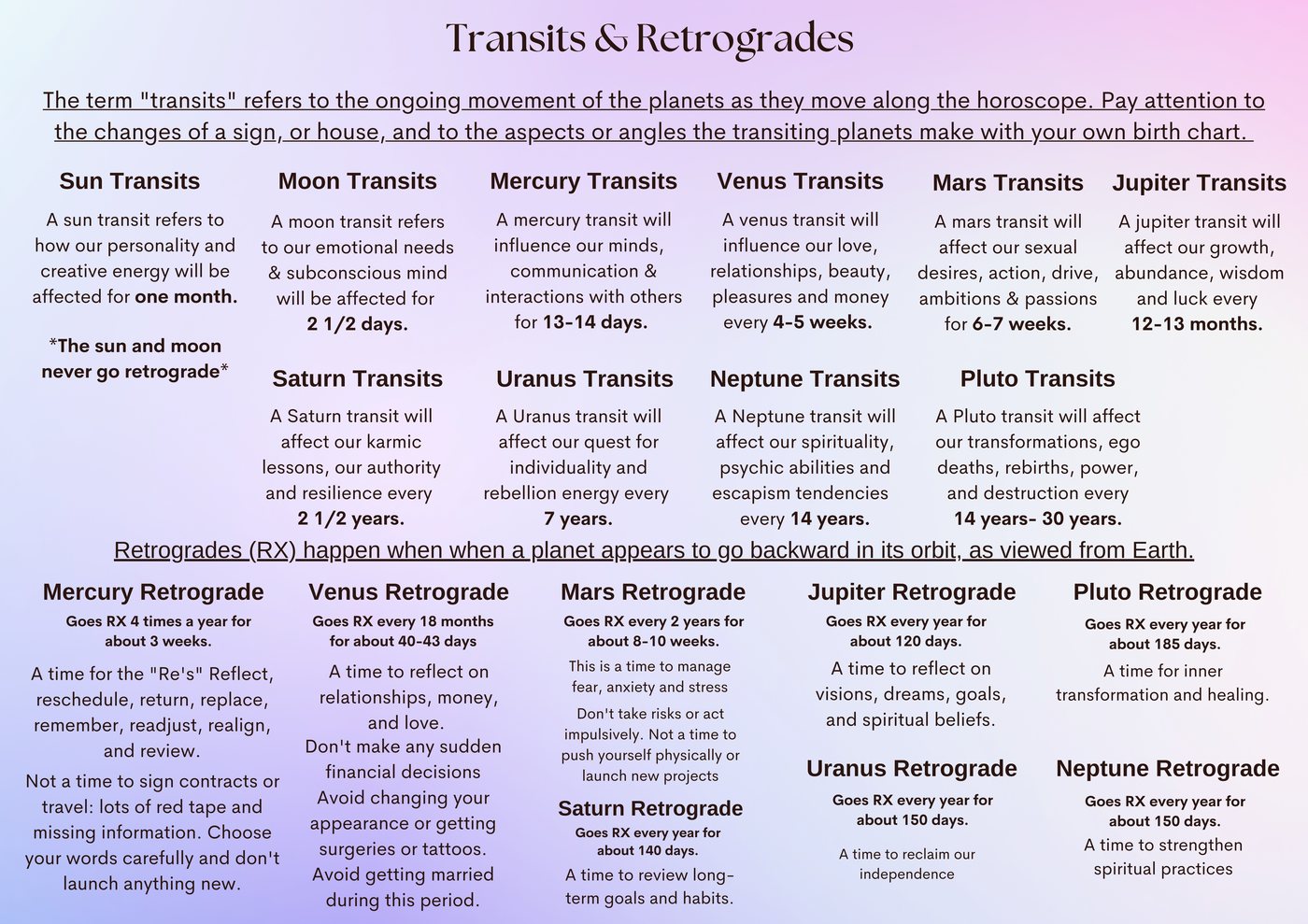
| Retrograde | How often | How long |
|---|---|---|
| Mercury ℞ | ~4 times a year | ~3 weeks |
| Venus ℞ | Every 18 months | ~40–43 days |
| Mars ℞ | Every 2 years | ~8–10 weeks |
| Jupiter ℞ | Yearly | ~120 days |
| Saturn ℞ | Yearly | ~140 days |
| Uranus ℞ | Yearly | ~150 days |
| Neptune ℞ | Yearly | ~150 days |
| Pluto ℞ | Yearly | ~185 days |
| Planet | Pre-shadow (approx) | Post-shadow (approx) |
|---|---|---|
| Mercury | ~2 weeks | ~2 weeks |
| Venus | ~3–4 weeks | ~3–4 weeks |
| Mars | ~6–8 weeks | ~6–8 weeks |
| Jupiter–Pluto | Several months each side — but since the outers are retrograde nearly half of every year, their shadows blur together and most astrologers only track shadows for Mercury, Venus, and Mars | |
Aspect Patterns
Yod — Finger of God
↓The apex is the finger — the focal point of the fated energy. Angles can participate; outer planets at the apex intensify it. The sextile base is gifted; the quincunxes create chronic adjustment and a restlessness that's hard to locate. It reads as a life mission the person struggles to consciously access.
Apex by modality — cardinal apex: the mission initiates, restlessness is action-oriented. Fixed apex: deeply internalized, harder to shift. Mutable apex: mental, scattered, communicative.
Boomerang Yod — add an opposition to the apex and the tension gets a release valve at the opposing planet:
T-Square & Grand Cross
↓Grand Cross (orb 6–8°) — the empty leg filled: four planets, two oppositions, four squares. Relentless four-way tension, incredible drive when integrated.
By modality — Cardinal: urgent, initiates constantly, struggles to finish. Fixed: the most intense — immovable willpower, locked patterns, transformation through breakdown or surrender. Mutable: scattered, adaptable, over-thinks instead of acting.
Grand Trine & Kite
↓Fire: charisma and confidence. Earth: practical genius, can get too comfortable. Air: intellectual brilliance, can live in the head. Water: emotional depth and psychic sensitivity, can drown in it.
Kite — a Grand Trine plus one planet opposing one of the trine planets and sextiling the other two. The opposition planet is the engine — it gives the passive trine direction and something to push against. The two planets it sextiles remain in trine to each other as the base of the triangle.
Thor's Hammer & Mystic Rectangle
↓Mystic Rectangle (orb 4–6°) — two oppositions (the gold diagonals) held together by two trines (solid long sides) and two sextiles (dashed short sides). Practical mysticism — holding paradox productively.
Grand Sextile & Cradle
↓Cradle (orb 4–6°) — one opposition (gold) bridged by a chain of sextiles, with trines running inside (dashed). Protective and gifted at softening conflict — but can rock itself to sleep inside its own comfort. The open side of the cradle is where growth lives.
Chart shapes
↓Bundle — all planets within about 120°. Hyper-focused, specialized, narrow and deep.
Bowl — one half of the chart occupied. The empty half becomes the life's longing — what the person reaches toward.
Bucket — a bowl plus one singleton handle on the empty side. The handle planet (pink) channels the entire chart and dominates regardless of its dignity.
Locomotive — planets spanning about 240°. The leading planet (pink — the first one clockwise into the empty space) is the engine driving the personality.
Seesaw — two opposing groups. A life of weighing, balancing, and negotiating between two worlds.
Splash — scattered through most signs. Versatile and wide-ranging, at risk of diffusion.
Stellium — not a shape but worth checking at the same moment: 3+ planets in one sign or house creates an overwhelming concentration the person can't escape.
Traditional Technique
The lunar nodes — Rahu & Ketu
↓North Node — the direction of growth. Unfamiliar, uncomfortable, and where the life is asking you to stretch.
South Node — the inheritance. Innate gifts and default patterns that feel like home — and can become a hiding place.
Why the dragon — in Vedic astrology the nodes are Rahu (north, the dragon's head) and Ketu (south, the dragon's tail). The myth: a demon drank the nectar of immortality, and the Sun and Moon exposed him — so Vishnu severed his head. Both halves survived, immortal but separated. The head that swallows without a body to fill: Rahu, insatiable hunger, obsession, worldly craving. The body that can never be fed: Ketu, detachment, renunciation, spiritual liberation. And because the severed dragon still chases the lights in revenge, eclipses happen at the nodes — the dragon swallowing the Sun or Moon.
Orbs for node contacts — most astrologers use a tight orb: 2–3° for conjunctions to the nodes (some allow up to 5° for the Sun or Moon). Because the nodes are points rather than bodies, wide aspects to them dilute quickly. A planet conjunct the North Node within a couple of degrees is a major life signature; at 7° it's noise.
Lilith — the three of her
↓1. Black Moon Lilith — the most used. Not an object at all: it's the lunar apogee, the point in the Moon's elliptical orbit farthest from Earth. The empty focus of the orbit. Themes: the rejected, the untamed, suppressed rage and sexuality, where you refuse to submit — and where you were exiled for refusing.
2. Asteroid Lilith (1181) — an actual rock in the asteroid belt, discovered in 1927. A real body with an orbit, and a much subtler, more specific influence. Far less used, and NOT interchangeable with Black Moon Lilith despite the shared name.
3. Dark Moon Lilith (Waldemath) — a hypothetical second moon of Earth proposed in the 1800s that was never confirmed to exist. Some older texts still list it.
Mean vs True Black Moon Lilith — same issue as the nodes. The lunar apogee wobbles, so the mean version is the smoothed average path (steady, most common default) while the true or osculating version tracks the actual jittery position and can swing several degrees, occasionally moving retrograde. Mean Lilith is what most software and most astrologers use unless specified.
When someone says "my Lilith is in Scorpio," they almost always mean mean Black Moon Lilith — but it's always worth asking which of the three.
Traditional vs modern rulers
↓Then Uranus, Neptune, and Pluto were discovered, and modern astrology reassigned Aquarius, Pisces, and Scorpio to them.
| Sign | Traditional ruler | Modern addition |
|---|---|---|
| Scorpio | Mars | Pluto |
| Aquarius | Saturn | Uranus |
| Pisces | Jupiter | Neptune |
Why still use modern as a second lens — the outers are real and they roar, especially by transit and when angular or tightly aspected. The clean method: run the chart on traditional rulership, then layer the outer planets on top as amplifiers, disruptors, and generational weather. Two lenses, one chart.
Sect — day charts and night charts
↓Day team: Sun, Jupiter, Saturn. Night team: Moon, Venus, Mars. Mercury switches — day sect if rising before the Sun, night sect if after.
How to actually SEE Mercury's sect on a chart — forget houses; compare degrees along the zodiac. Mercury never strays more than about 28° from the Sun, so it's always close by. If Mercury sits at an earlier zodiac position than the Sun (Sun 15° Leo, Mercury 4° Leo — or 27° Cancer), Mercury clears the horizon first each morning: a morning star, rising before the Sun, day sect. If Mercury sits later in the zodiac (Sun 15° Leo, Mercury 26° Leo — or 3° Virgo), the Sun rises first and Mercury trails behind, visible after sunset: an evening star, rising after, night sect. On the wheel: earlier degree = the clockwise side of the Sun = rises first.
In-sect planets express their best qualities; out-of-sect planets run hotter and less controlled. The big one is the malefics: Saturn in sect (day) builds with purpose, out of sect (night) turns colder and heavier. Mars in sect (night) is focused courage, out of sect (day) is impulsive and combustive.
Hayz — the triple crown: a planet in sect AND in a sign matching its sect's gender AND on the correct side of the horizon.
What "gender" means here — traditional astrology classifies the signs in an alternating pattern: fire and air signs are masculine/diurnal (yang, expressive); earth and water signs are feminine/nocturnal (yin, receptive). Day-team planets prefer masculine signs; night-team planets prefer feminine signs.
A full example — someone born at noon (day chart) with Saturn in Aquarius in the 9th house: Saturn is a day planet in a day chart ✓ in sect. Aquarius is an air sign — masculine ✓ gender match. The 9th house is above the horizon, where day planets belong by day ✓ hemisphere. All three conditions met: Saturn in hayz — about as comfortable as Saturn ever gets, delivering structure and mastery with minimal cruelty.
Overcoming & accidental dignity
↓Accidental dignity — strength by situation. Essential dignity is a planet's intrinsic quality by sign; accidental dignity is how well-positioned it is to ACT. A planet gains accidental strength by being: angular (especially 1st or 10th), direct and swift in motion, free of the Sun's beams, in its planetary joy, attended by benefics, or on a royal fixed star.
Peregrine — the opposite condition. A planet is peregrine when it has NO essential dignity whatsoever at its degree: not in its own sign, not exalted, not the triplicity ruler, not the bound lord, not the decan ruler. Zero claims on where it stands. The word means "wandering" or "foreigner" — and that's exactly the image: a stranger in a country where they hold no property, no title, and no rights. A peregrine planet still acts, but without resources or backing; it improvises, borrows, and depends on whoever else in the chart will support it. Traditionally counted as a debility roughly on par with detriment. Check for it whenever a planet's behaviour seems oddly rootless — and note that a peregrine planet sitting angular can still be extremely loud, just ungrounded.
Two examples that show why both matter — Mars in Taurus (essential detriment) sitting conjunct the Midheaven: essentially uncomfortable but accidentally loud — it WILL express, publicly, whether polished or not. Venus in Pisces (exalted, essentially glorious) buried in the 12th house, combust: a beautiful voice with the microphone off. Essential dignity is the quality of the instrument; accidental dignity is whether it's on stage or in the basement.
Bonification & maltreatment
↓This is the language for why a dignified planet still underperforms — Venus in Libra besieged can't express her dignity — and why a rough placement sometimes delivers anyway.
Combustion, cazimi & under the beams
↓| Condition | Distance | Effect |
|---|---|---|
| Under the beams | within 17° | Dimmed, weakened |
| Combust | within 8° | Burned — voice lost, maltreated |
| Cazimi | within 17 minutes of arc | In the heart of the Sun — empowered, elevated |
Minutes of arc — each degree divides into 60 minutes ('), each minute into 60 seconds ("). So 17' is under a third of one degree. Two planets can share a degree number and still not be cazimi — Sun 14°05' and Venus 14°55' are 50 minutes apart. Check the data table, not the wheel.
Trigon lords / triplicity rulers
↓| Element | Day | Night | Participating |
|---|---|---|---|
| Fire | Sun | Jupiter | Saturn |
| Earth | Venus | Moon | Mars |
| Air | Saturn | Mercury | Jupiter |
| Water | Venus | Mars | Moon |
Angular, succedent & cadent houses
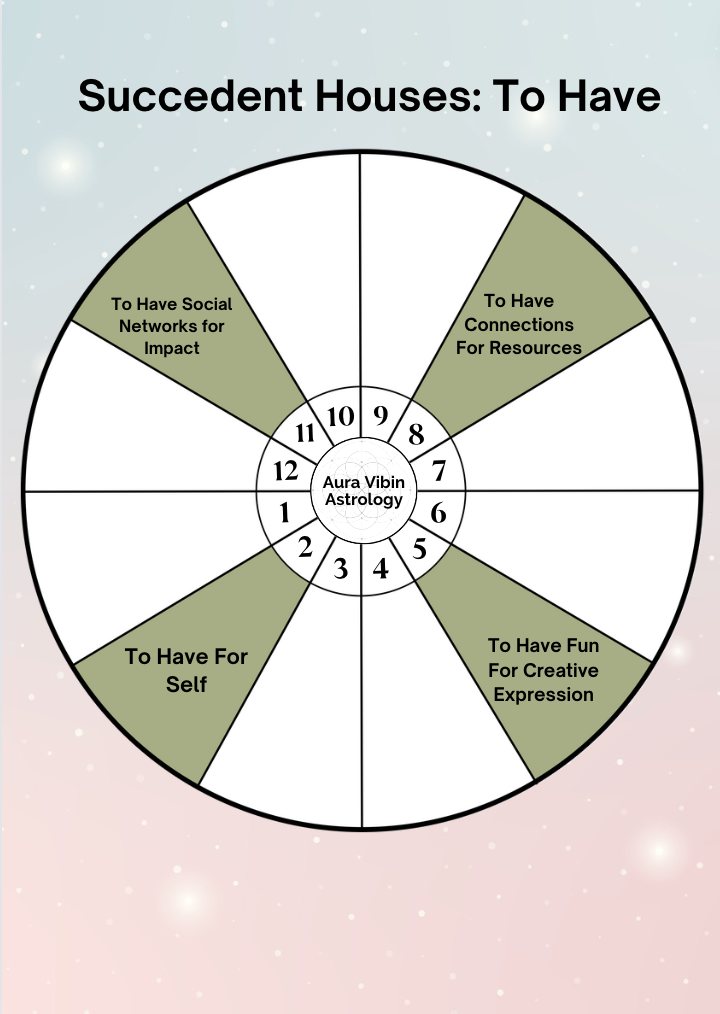
↓Succedent (2, 5, 8, 11) — steady, building strength. Power that develops over time rather than radiating instantly.
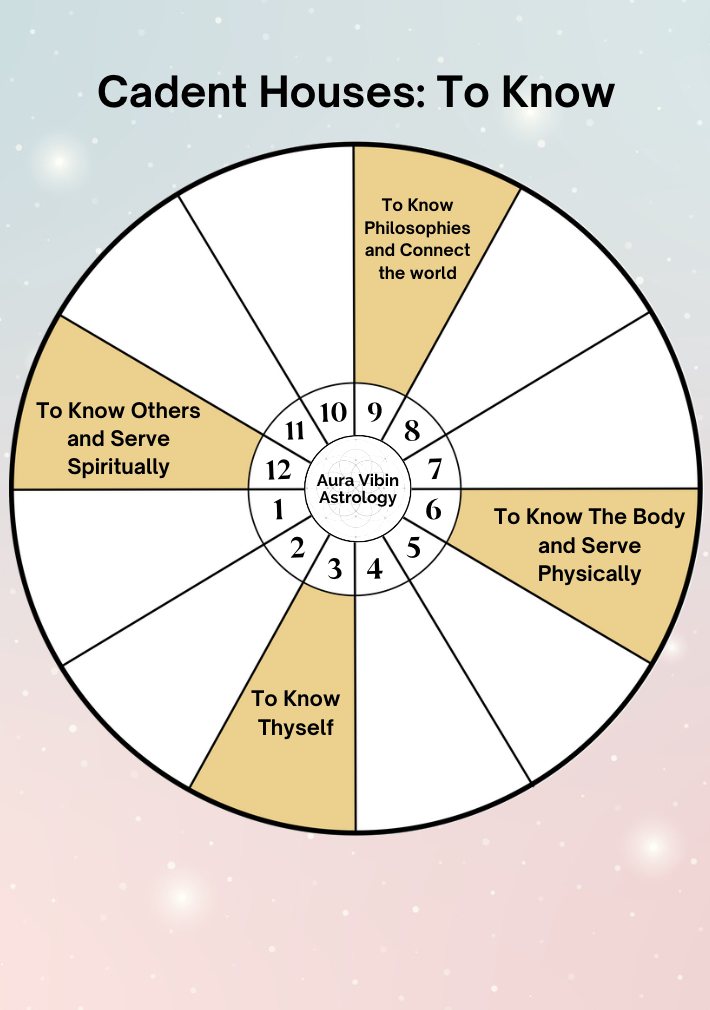
Cadent (3, 6, 9, 12) — traditionally weakest for outward action; more internal, mental, spiritual, diffuse.
Angular = loud. Succedent = steady. Cadent = internalized. Always weigh house position against sign dignity — an exalted planet in the 12th is pure but struggles to act; a debilitated planet on the MC still expresses loudly.
Barren & fruitful signs
↓| Category | Signs |
|---|---|
| Barren | Gemini, Leo, Virgo |
| Semi-barren | Aries, Sagittarius, Aquarius |
| Semi-fruitful | Taurus, Capricorn, Libra |
| Fruitful | Cancer, Scorpio, Pisces |
Zodiacal releasing
↓Each sign's ruler governs a set number of years: Moon 25, Mercury 20, Venus 8, Sun 19, Mars 15, Jupiter 12, Saturn 30. Periods nest into sub-periods (levels 1–4).
Loosing of the bond — when the sequence hits a sign square or opposite the starting Lot — marks the major turning points: career breaks, public recognition, pivotal decisions. Free calculators exist on Astro-Seek. Most timing techniques show what's happening; zodiacal releasing shows what chapter of the story you're in.
Annual profections — your theme of the year
↓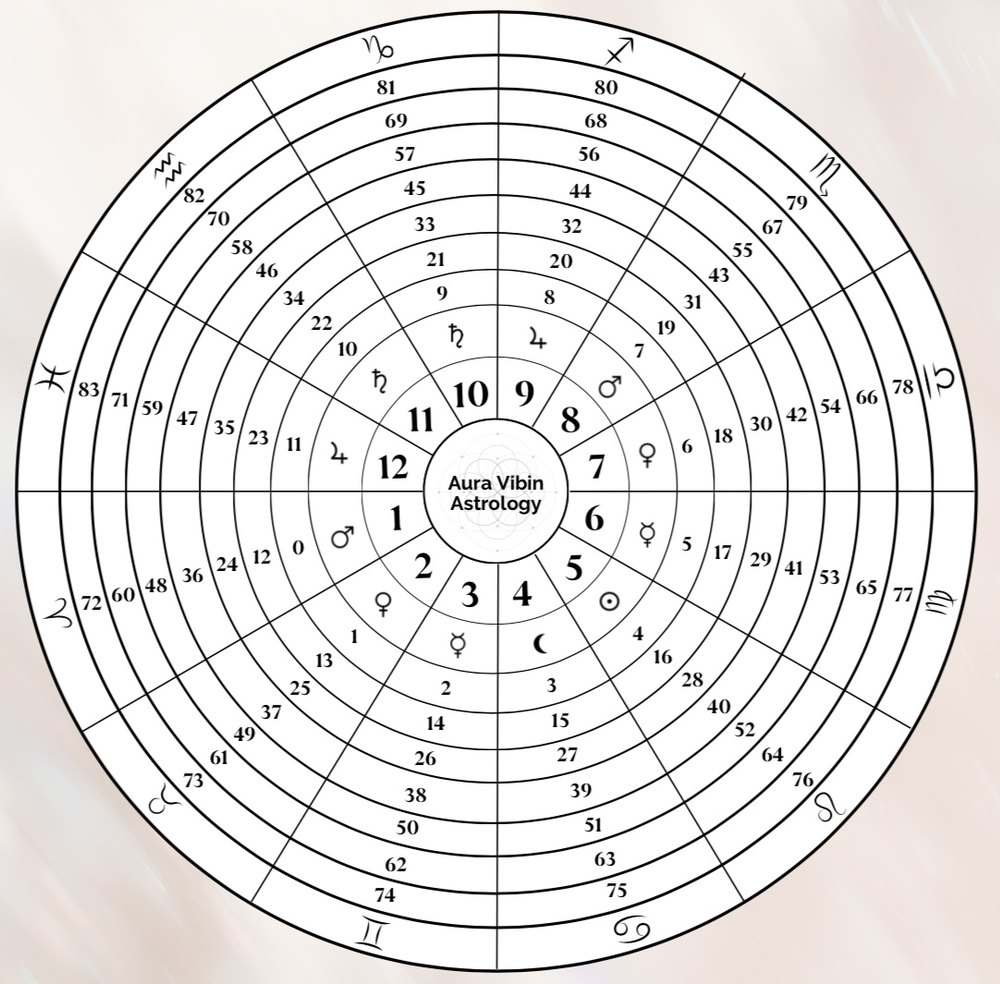
| House | Ages | The Year Of | Theme |
|---|---|---|---|
| 1st | 0 · 12 · 24 · 36 · 48 · 60 · 72 | Identity & Initiation | Personal rebirth — an energetic New Year opening a fresh 12-year cycle. Identity, self-concept, appearance, personal power. |
| 2nd | 1 · 13 · 25 · 37 · 49 · 61 · 73 | Worth & Wealth | A reclamation of value. Self-worth, money, values, stability, voice. |
| 3rd | 2 · 14 · 26 · 38 · 50 · 62 · 74 | Mind & Messaging | A mental renaissance. Mindset, communication, learning, expression, siblings. |
| 4th | 3 · 15 · 27 · 39 · 51 · 63 · 75 | Roots & Remembering | Emotional anchoring and ancestral healing. Foundations, family, belonging, homecoming. |
| 5th | 4 · 16 · 28 · 40 · 52 · 64 · 76 | Creativity & Confidence | The glow-up year — create, express, be fully seen. Romance, joy, magnetic visibility. |
| 6th | 5 · 17 · 29 · 41 · 53 · 65 · 77 | Sacred Structure | Becoming reliable to your future self. Devotion, discipline, health, embodied service. |
| 7th | 6 · 18 · 30 · 42 · 54 · 66 · 78 | Mirror Work | Relationships take center stage — partners become the curriculum. Contracts, reflection, sacred union. |
| 8th | 7 · 19 · 31 · 43 · 55 · 67 · 79 | Sacred Alchemy | A descent and metamorphosis. Transformation, power, intimacy, death & rebirth, soul contracts. |
| 9th | 8 · 20 · 32 · 44 · 56 · 68 · 80 | The Great Becoming | The spirit stretches beyond its old edges. Expansion, faith, truth, wisdom, vision. |
| 10th | 9 · 21 · 33 · 45 · 57 · 69 · 81 | Visibility | The world takes notice — work becomes legacy. Career, purpose, public life, mastery. |
| 11th | 10 · 22 · 34 · 46 · 58 · 70 · 82 | Expansion | Your network becomes your net worth. Community, vision, influence, support, innovation. |
| 12th | 11 · 23 · 35 · 47 · 59 · 71 · 83 | The Unseen | Sacred stillness before the rebirth. Solitude, surrender, subconscious, spiritual renewal, completion. |
Monthly profections — the same wheel can run monthly: starting from your birthday each year, the profected house advances one house per month, giving each month within your year its own sub-theme. A 7th house year with a 10th house month is relationship growth expressing through career and visibility.
The Branches of Astrology
The four classical branches
↓Natal — the birth chart. Character, potential, timing of a single life. The foundation everything else builds on.
Horary — a chart cast for the exact moment a burning question is asked and understood. "Where are my lost keys? Will I get the job? Is he telling the truth?" The chart itself answers, through the significators (the querent's ruler, the quesited's ruler) and the aspects forming between them. Governed by strict rules — radicality, considerations before judgment, translation and collection of light. Used when you need a specific answer to a specific question, now.
Electional — the reverse of horary. Instead of reading a moment that arrived, you CHOOSE a moment to begin something — a wedding, a launch, a surgery, signing a contract — by finding a chart with the dignities and angles that favor the venture. Traditional astrology's most practical, empowering branch.
Mundane — the astrology of the world rather than the person: nations, politics, economies, weather, collective cycles. Read through ingress charts (the Sun entering Aries as the year's chart), eclipses, and the great outer-planet conjunctions that mark historical eras.
And the branches beyond the classical four:
Medical — mapping signs and planets to the body and its ailments; the decumbiture chart cast for the moment illness takes hold. Historically inseparable from medicine itself.
Horoscopic / Sun-sign columns — the newspaper horoscope everyone knows. It reads transits against a single factor (the Sun sign) rather than a full chart, which is why it's general by design. It's the shallowest end of the pool, but it's the door most people walk through — and there's no shame in it being someone's first step.
Evolutionary — reading the chart as the soul's journey across lifetimes, centered on Pluto and the nodes. Modern, psychological, deeply popular.
Relational (synastry & composite) — the astrology of the space between two people.
Astrocartography / locational — how your chart activates differently depending on where on Earth you stand.
Financial — planetary cycles applied to markets and commodity timing. A real professional niche.
Astrometeorology — forecasting weather from planetary cycles; one of astrology's original applied uses.
Katarchic / inceptional — the ancestor of both horary and electional: reading the chart of any beginning, including ones you didn't choose.
How to read a birth chart — the full sequence
↓2. The Players — the ten planets as core drives, luminaries first, dignities, retrogrades.
3. The Signs — twelve modes of expression, elements as operating systems, modalities as how energy moves.
4. The Houses — angular/succedent/cadent, cusps, empty houses, stelliums, house rulers.
5. The Aspects — majors, applying/separating, orbs, patterns, prioritizing.
6. The Chart Ruler — ruler of the ASC sign, its condition, house, aspects, dispositors.
7. Synthesis — building one story from many factors; the actual skill.
8. Timing — transits, progressions, solar returns, profections, eclipses.
Fixed stars
↓| Star | ~Position | Signature |
|---|---|---|
| Regulus | ~0° Virgo | The royal heart of the Lion — honor, success, and a fall if revenge is taken |
| Spica | ~24° Libra | The most fortunate star — brilliance, gifts, protection |
| Algol | ~26° Taurus | The Medusa star — the most intense in the sky; rage, danger, and raw female power |
| Aldebaran | ~10° Gemini | Royal Watcher — integrity rewarded, but only if you never compromise it |
| Antares | ~10° Sagittarius | Royal Watcher — intensity, obsession, war, transformation |
| Sirius | ~14° Cancer | The brightest star — sacred fire, ambition, the "scorching" of greatness |
| Fomalhaut | ~4° Pisces | Royal Watcher — idealism, mysticism, fame through vision |
Thema Mundi — the birth chart of the world
↓It places Cancer rising, with every planet in its own domicile: Moon in Cancer on the ASC, Sun in Leo, Mercury in Virgo, Venus in Libra, Mars in Scorpio, Jupiter in Sagittarius, Saturn in Capricorn. From this single arrangement the ancients derived the logic of the entire tradition:
Why the domicile rulerships are ordered as they are · why Cancer and Leo (Moon and Sun) sit at the top of the chart's natural hierarchy · why the aspects mean what they mean — a square is hard because from Cancer, the squaring signs are the ones that share nothing with it · why Saturn opposes the lights (it's placed opposite Cancer and Leo). It's not a chart to interpret — it's the Rosetta Stone that decodes why every other chart is read the way it is.
Who to study — the lineage
↓The astronomer-astrologers — Johannes Kepler, who cast charts professionally while revolutionizing astronomy, refined the minor aspects, and sought a mathematical-harmonic basis for astrology; Tycho Brahe and even Galileo practiced it. The split between astronomy and astrology is only a few centuries old.
The modern voices — Alan Leo and Dane Rudhyar (founders of psychological/humanistic astrology), Liz Greene (astrology meets Jungian depth psychology), Robert Hand and Project Hindsight (who recovered the lost Hellenistic material), Chris Brennan (Hellenistic Astrology and The Astrology Podcast — the best modern on-ramp to traditional technique), and popular-practice authors like Jan Spiller (nodes and soul purpose).
A path that works: Brennan's podcast and book to understand the traditional skeleton, Forrest or Greene for psychological depth, then Valens and Lilly once you want to drink from the source.
The standout planets — elevated, leading & retrograde
↓The most elevated planet — the planet sitting highest in the chart, closest to the Midheaven. Being at the top means being the most publicly visible and least hidden: it's the planet the world sees, the one that colors reputation, career direction, and what people associate with you before they know you. Elevation is a form of accidental dignity — a badly dignified planet at the MC still shouts, it just shouts its own nature. Saturn most elevated reads as authority, seriousness, and slow-built legitimacy; Neptune most elevated as an image that's dreamy, blurred, artistic, or hard to pin down.
The leading planet — in a Locomotive chart shape (planets spanning roughly 240° with an empty third), the leading planet is the one at the head of the group in the clockwise direction — the direction the whole sky appears to travel each day. Picture the chart turning: that planet is out front, pulling the others behind it. It functions as the engine of the personality, the drive everything else follows. In a Bucket shape, the equivalent is the handle — the lone planet opposite the cluster, which channels the entire chart through itself and dominates regardless of dignity.
The oriental planet — rising before the Sun. A separate idea that gets tangled with the one above, and worth keeping distinct. A planet is oriental when it sits at an earlier zodiacal degree than the Sun, so it clears the horizon first each morning and appears in the dawn sky as a morning star. Going clockwise from the Sun, it's the first planet you meet. Tradition treats this as a mark of prominence: the planet that leads the Sun into the day was said to herald it, and in Hellenistic practice a planet rising before the Sun could act as a doryphory — a spear-bearer, a bodyguard escorting the luminary — which was one of the classical indicators of eminence in a life.
| Planet ℞ | How it tends to show |
|---|---|
| Mercury | Thinks before speaking, processes internally, may have felt slow or misunderstood early on. Often exceptional writers and deep thinkers — the mind takes a longer, more original route. |
| Venus | Unconventional relating and values. Love and self-worth are learned deliberately rather than absorbed; attraction patterns often need conscious revision. |
| Mars | Anger and desire turn inward before outward. Assertion is a skill that has to be built, not a reflex — action arrives after long internal deliberation. |
| Jupiter | Faith and meaning must be found personally rather than adopted from culture or family. Growth is internal before it's external. |
| Saturn | Authority is questioned rather than obeyed. The inner critic runs harsh, and the work is building self-authored structure instead of borrowed rules. |
| Uranus · Neptune · Pluto | Retrograde for months every year, so they're generational rather than personal. Only read as individually significant when tightly aspecting a personal planet or angle. |
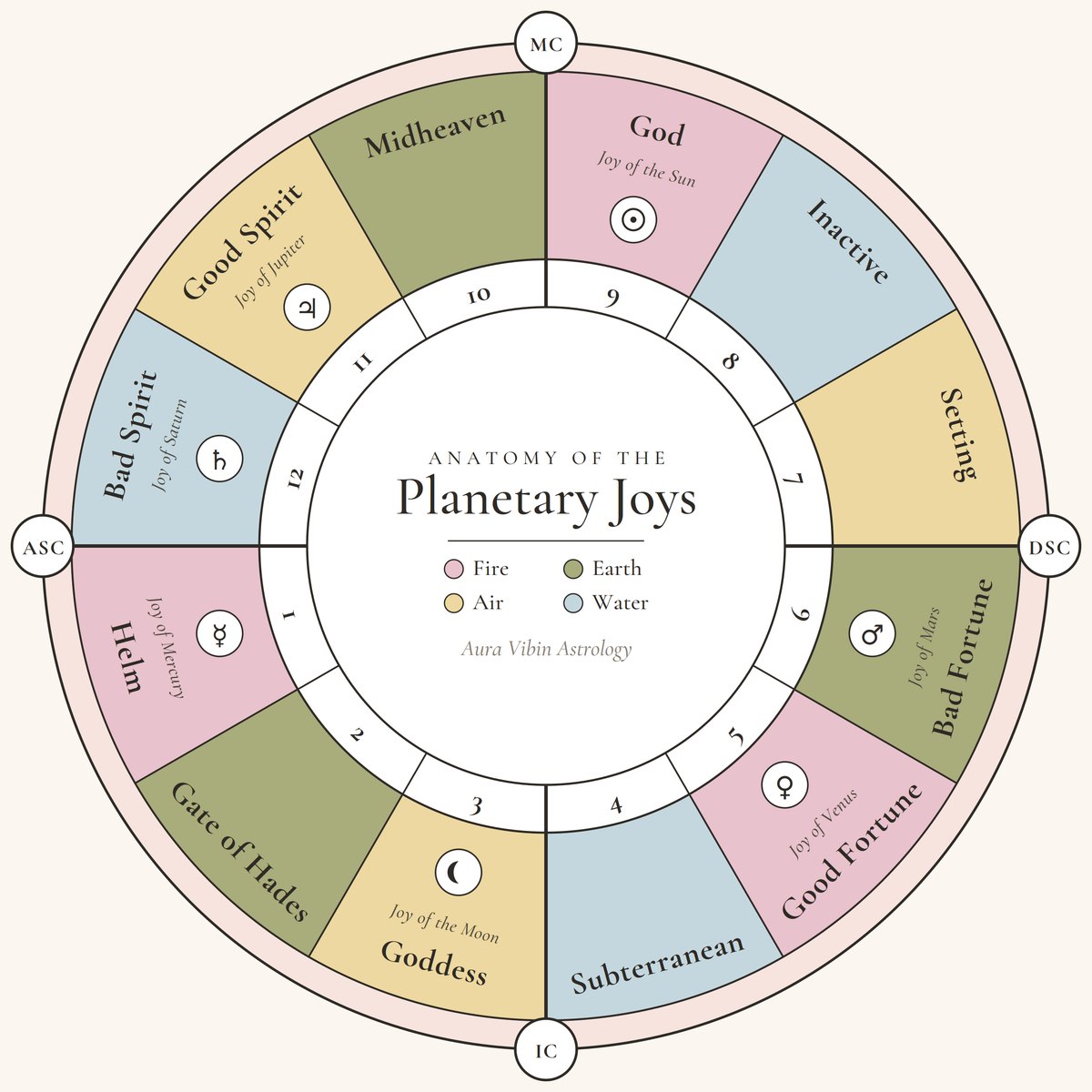
The Planetary Joys
↓
The seven joys
| Planet | Joy | House name |
|---|---|---|
| Mercury | 1st | Helm / Life |
| Moon | 3rd | Goddess |
| Venus | 5th | Good Fortune |
| Mars | 6th | Bad Fortune |
| Sun | 9th | God |
| Jupiter | 11th | Good Spirit |
| Saturn | 12th | Bad Spirit |
Mercury in the 1st. The first house is the point of the rising sign, the body, the self stepping into the world — the most active, awake, "here I am" house. Mercury is the planet of alertness, perception, and the mind engaging its surroundings. The messenger rejoices where the chart is most awake.
Moon in the 3rd. The third is the house of daily rhythms, siblings, neighbours, short journeys, the ordinary comings and goings of life. The Moon moves faster than any body, changing sign every two to three days — she rejoices in the house of constant small motion and everyday care.
Venus in the 5th. The fifth is pleasure, children, love affairs, creativity, play — everything Venus is. This is the most straightforward joy: the planet of delight in the house of delight. It's even called Good Fortune.
Mars in the 6th. Here's where it gets subtle. The sixth is illness, labour, toil, conflict — hard, unglamorous houses. Mars rejoices here not because it's pleasant, but because the sixth is where Mars's aggression has a job to do. Contained in the house of work and struggle, Mars's fighting energy is put to use rather than let loose to wreck the more delicate areas of life. A difficult planet is happiest where difficulty is expected.
Sun in the 9th. The ninth is the house of God, higher knowledge, philosophy, the divine, the long journey toward meaning. The Sun is the light of consciousness and spirit. It rejoices in the house that looks upward — literally called God.
Jupiter in the 11th. The eleventh is friends, alliances, hopes, good fortune arriving through community — the house of Good Spirit. Jupiter is benevolence, expansion, blessing. The great benefic rejoices in the house of collective good will.
Saturn in the 12th. The twelfth is solitude, loss, confinement, the hidden, the undoing — the house of Bad Spirit. Saturn is the planet of limitation, isolation, and endings. Like Mars in the sixth, Saturn rejoices here because its heavy nature belongs to the house of retreat and dissolution. The planet of solitude is at home in the house of solitude.
Mythology
The stories the meanings grew out of. Learn the myth and the astrology stops being a list to memorize.
Why Solstere?
↓Sol. The Sun is the heart of any chart — your core identity, your vitality, the light you're here to shine. Everything in astrology begins with the Sun's position and radiates outward. To know yourself through the stars is to start at the center: your own light.
Stere. The stars give that light its architecture. The signs, houses, and angles are the measured, dimensional space the light moves through — the structure that turns raw radiance into meaning. Stereos is where we get words for solidity and space: the sky made tangible, mappable, knowable.
Why mythology matters — and where to begin
↓When an astrologer says Saturn is about limitation, endurance, and the fear of being surpassed, they are not reciting a list someone invented. They are describing Kronos — the god who swallowed his children to keep his throne. The planet means what it means because of the story. Learn the story and you never have to memorise the keywords again; they fall out of the myth on their own.
Why this is worth researching, not just reading. These stories are among the oldest surviving records of how human beings made sense of existence — birth, death, love, betrayal, power, transformation. They encode patterns that recur in every life, which is exactly why they map onto a chart at all. Sitting with them doesn't just make you a better astrologer; it connects you to the people who watched the same sky for thousands of years and felt the same things you feel. That's not a small thing. It's a way of belonging to something much larger than one lifetime.
2. Then the three outer planets — Uranus, Neptune, Pluto — and why they carry forces bigger than a single life.
3. Then the nodes (Rahu & Ketu) and Chiron — the karmic and healing layer.
4. Then step back into the source cultures — the civilisations these stories actually came from, in the order they shaped astrology:
• Egypt first. This is where the decans (the 36 star-groups that became the 10° faces), the sky-goddess Nut, and the god Thoth all begin — and Thoth later became Hermes Trismegistus, whose name is on the Hermetic lots you'll use in charts. Start with the Egypt entries below, then if you want to go deeper, look into The Egyptian Book of the Dead (any annotated edition) and the myth cycle of Isis and Osiris — Plutarch's On Isis and Osiris is the classic ancient source.
• Then Greece and Rome. This is where the planet-gods you already use get their fullest personalities — Kronos/Saturn, Ares/Mars, Aphrodite/Venus. The two most accessible doorways are Hesiod's Theogony (the origin of the gods, including Kronos swallowing his children) and Ovid's Metamorphoses (the great storehouse of the transformation myths). For a modern retelling, Stephen Fry's Mythos is the gentlest entry, and Edith Hamilton's Mythology is the classic student's companion.
• Then the Vedic thread. "Vedic" means the astrology and mythology of ancient India — Jyotisha, the sister system to Western astrology. This is where Rahu and Ketu (the dragon's head and tail, the eclipse points) come from. The stories live in the Mahabharata and the Puranas; the churning-of-the-ocean myth in the Ketu entry below is the doorway. You don't need to practise Vedic astrology to let its myths deepen how you read the nodes.
Each entry below is written to be read in roughly this order — but there's no wrong door. If a particular god pulls at you, start there.
Don't try to hold it all at once. Read one myth, sit with it, watch where it shows up in a chart you know. The connections build themselves once you stop rushing.
Saturn — Kronos, the god who ate time
↓Chiron — the wounded healer
↓Mars — Ares vs the Norse Tyr
↓Venus — Aphrodite & Inanna's descent
↓Mercury — Hermes the boundary-crosser
↓Jupiter — Zeus, king of expansion
↓Rahu & Ketu — the dragon that swallows the lights
↓The Sun and the Moon saw him. They spoke. And Vishnu, hearing it, threw his discus and severed the demon's head from his body in the same instant the nectar reached his throat.
It was already too late. He had swallowed. Both halves were immortal, and both halves survived — permanently separated, permanently incomplete.
The head became Rahu. A mouth and a throat with no stomach beneath it: he can consume endlessly and never be filled. This is the North Node — insatiable appetite, obsession, craving, the pull toward more of something you have never had.
The body became Ketu. A form with no mouth to feed it: it cannot take anything in, so it needs nothing. This is the South Node — detachment, renunciation, the mastery you already carry, and the release of wanting.
The astronomy underneath is exact. Eclipses can only occur near the lunar nodes — the very points named Rahu and Ketu. The myth is a precise description of celestial mechanics, told as a story of appetite and revenge thousands of years before anyone drew the geometry.
Egypt — where the decans were born
↓The 36 decans. The Egyptians divided the sky into thirty-six star groups, each rising just before dawn for roughly ten days a year. Together they formed a star clock: the night's hours were told by which decan was rising. Thirty-six decans of ten days each gave a 360-day year, with five extra days added on. When the Greeks inherited this, the decans became the 10° divisions of each zodiac sign — the same thirty-six, mapped onto a new frame. Every time you read a decan, you're using an Egyptian instrument.
Nut, the sky. The sky was a goddess: Nut, arched over the earth on fingertips and toes, her body covered in stars. Each evening she swallowed the Sun; each dawn she gave birth to it again. The sky was not a place in Egyptian thought — it was a body, and celestial events were things happening to someone.
Ra and the solar barque. The Sun crossed the daytime sky in a boat, then descended into the Duat — the underworld — to sail through twelve hours of night, facing the serpent Apep in the darkest hour before rising renewed. Twelve hours of visible sky, twelve of the invisible: an early ancestor of the twelvefold division, and of the day/night sect distinction that still runs through traditional astrology.
Thoth, the measurer. Ibis-headed god of writing, calculation, time, and the Moon — keeper of the records and inventor of the sciences. When Greek culture met Egyptian, Thoth merged with Hermes to become Hermes Trismegistus, "Thrice-Great Hermes," the legendary author of the Hermetic texts. The Hermetic lots — Fortune, Spirit, Eros, Necessity, Courage, Victory, Nemesis — carry his name because of this fusion. Mercury's connection to writing, measurement, and hidden knowledge runs straight back to an Egyptian god of the Moon.
Sirius, Sopdet, and the new year. The most important star in Egypt was Sirius — Sopdet, later identified with Isis. After seventy days invisible below the horizon, its heliacal rising (its first reappearance just before dawn) coincided with the annual flooding of the Nile, and marked the Egyptian new year. An entire civilization set its calendar by a single star's return. The technique of heliacal rising and setting — a planet's disappearance into the Sun's beams and its return — remains a live part of traditional astrology.
Osiris & the Duat — Orion in the night sky
↓And then look up. Osiris in the sky is Sah — the constellation we call Orion. Isis is Sopdet — Sirius, which rises just behind him, night after night, following. The story of the wife pursuing her husband across the world is a description of what those two stars actually do.
The death and return is also literal. Sirius vanishes below the horizon for about seventy days each year before its heliacal rising brings the Nile flood — and the Egyptian mummification rite lasted about seventy days. The funeral practices of an entire civilisation were timed to a star's disappearance and return. Death, a fixed period of invisibility, then rising again: the myth, the ritual, and the sky are the same document.
The Duat itself is usually translated "underworld," which misleads. It is not beneath the ground in the way we picture it — it is a region of the night sky, the part of the heavens the Sun passes through between setting and rising. Texts like the Amduat ("that which is in the Duat") and the Book of Gates map it as twelve hours with twelve gates, each with its own trial and its own guardian.
Horus — the sky, and the moon as a healing eye
↓His right eye is the Sun. His left eye is the Moon. Two lights in one face, which is already the entire logic of sect — the diurnal light and the nocturnal light belonging to a single sky.
Then comes the injury. In the long war against Set to avenge his father, Horus's left eye — the Moon — was torn out and shattered into pieces. Thoth, god of measurement and calculation, gathered the fragments and restored it. The healed eye became the wedjat, the Eye of Horus, worn as protection for thousands of years.
Amenti, Maat & the weighing of the heart
↓The Hall of Two Truths is where the newly dead arrive. The heart is placed on a scale and weighed against a single ostrich feather — the feather of Maat. Thoth stands by and records the result. A heart heavier than the feather has carried too much, and is devoured; a heart in balance passes on into the field of reeds.
Maat is the concept underneath everything. She is truth, balance, justice, and cosmic order — but crucially, not order imposed on the world from outside. Maat is the pattern the world already runs on: the Sun rising on schedule, the flood arriving on time, the stars returning to their places season after season. Her opposite is isfet, chaos, and the pharaoh's central duty was to uphold maat against it. Every ritual, every alignment, every measurement was a way of keeping the human world in step with the celestial one.
The outer planets — Uranus, Neptune, Pluto
↓The Moon & the lunar goddesses
↓The twelve signs — where their stories come from
↓♈ Aries — the Ram of the Golden Fleece. The winged ram with fleece of gold carried two children away from being sacrificed, flying them to safety. Its fleece became the object of Jason's quest. Aries is the rescuer's headlong courage — the one who acts first, charges in, saves the day before thinking. Ruled by Mars; the initiator.
♉ Taurus — the Bull, Zeus in disguise. Zeus transformed into a magnificent white bull to win Europa, who climbed onto his back before he carried her across the sea. Taurus is the sign of the body, the senses, beauty, and steady physical presence — the bull that is gentle until moved. Ruled by Venus; the stabilizer.
♊ Gemini — the Twins, Castor and Pollux. Two brothers, one mortal and one immortal, so devoted that when the mortal died, the immortal begged to share his own eternal life rather than be parted. Zeus set them both in the stars. Gemini is duality, connection, the two-in-one mind. Ruled by Mercury; the communicator.
♋ Cancer — the Crab. During Heracles' battle with the Hydra, a crab crept in to pinch his foot in loyalty to Hera. It was crushed for its trouble — but Hera honored its devotion with a place in the sky. Cancer is loyalty, protection, and the tender heart that defends what it loves. Ruled by the Moon; the nurturer.
♌ Leo — the Nemean Lion. The monstrous lion whose hide no weapon could pierce, slain by Heracles as his first labour. Placed in the heavens as a mark of the feat. Leo is sovereignty, radiance, the untouchable pride of the king of beasts. Ruled by the Sun; the sovereign.
♍ Virgo — the Maiden, often Astraea or Demeter. Astraea, goddess of justice and innocence, was the last immortal to leave earth as humanity fell into corruption — she ascended to become the constellation, holding the scales of Libra beside her. Virgo is purity, service, discernment, the sacred harvest. Ruled by Mercury; the perfecter.
♎ Libra — the Scales. The only zodiac sign that is an object, not a creature — the scales of justice held by Astraea/Themis, weighing right against wrong. Once considered the claws of the Scorpion, later set apart as balance itself. Libra is harmony, fairness, relationship, the search for equilibrium. Ruled by Venus; the harmonizer.
♏ Scorpio — the Scorpion that felled Orion. The great hunter Orion boasted he could kill any beast, so the earth sent a scorpion that stung him dead. Both were placed in the sky at opposite ends — so that as Scorpio rises, Orion flees below the horizon. Scorpio is death, transformation, the sting that ends and remakes. Ruled by Mars (traditional) and Pluto (modern); the transformer.
♐ Sagittarius — the Centaur archer, Chiron. The wise centaur — half man, half horse — teacher of heroes, aiming his arrow at the stars. Often identified with Chiron himself. Sagittarius is the quest for meaning, the arrow of aspiration flying toward truth and the far horizon. Ruled by Jupiter; the seeker.
♑ Capricorn — the Sea-Goat. A strange hybrid — the god Pan, fleeing the monster Typhon, dove into the Nile and transformed his lower half into a fish while his upper half stayed a goat. The sea-goat climbs the highest mountain and descends the deepest water: worldly ambition rooted in hidden depths. Ruled by Saturn; the builder.
♒ Aquarius — the Water-Bearer, Ganymede. A beautiful youth carried to Olympus by Zeus (as an eagle) to become cupbearer to the gods, pouring out the waters of life for all. Aquarius is the humanitarian, pouring knowledge and vision out to humanity — the future-minded gift-giver. Ruled by Saturn (traditional) and Uranus (modern); the visionary.
♓ Pisces — the Two Fish. Aphrodite and her son Eros, escaping the same monster Typhon, turned into fish and tied themselves together with a cord so they would not lose each other in the water. Pisces is the two fish swimming in opposite directions, bound together — the mystic, the dreamer, the dissolver of boundaries between self and all. Ruled by Jupiter (traditional) and Neptune (modern); the mystic.
Books to Research
Where to begin — foundations
↓Chart Interpretation Handbook — Stephen Arroyo. Clear, grounded synthesis of signs, planets, houses, aspects.
You Were Born For This — Chani Nicholas. Modern, accessible, and strong on turning placements into lived practice.
Astrology for the Soul — Jan Spiller. The popular entry point to the lunar nodes and soul purpose.
The Twelve Houses — Howard Sasportas. The deep, definitive book on the houses as arenas of life.
The Houses: Temples of the Sky — Deborah Houlding. Shorter, traditional, and brilliant on where house meanings actually came from.
Psychological & depth astrology
↓Saturn: A New Look at an Old Devil — Liz Greene. The book that reframed Saturn from curse to teacher; her Chiron and relationship work is equally essential.
The Astrology of Fate — Liz Greene. Fate, myth, and the deep structure of a life.
Astrology, Psychology & the Four Elements — Stephen Arroyo. A modern classic on temperament and energy.
Cosmos and Psyche — Richard Tarnas. Sweeping, serious work linking outer-planet cycles to history and culture. Heavy but transformative.
Traditional & Hellenistic
↓Hellenistic Astrology: The Study of Fate and Fortune — Chris Brennan. The definitive modern guide to the tradition. If you buy one serious book, this is it.
Astrology and the Authentic Self — Demetra George. A bridge between traditional technique and psychological meaning.
Ancient Astrology in Theory and Practice — Demetra George. Deeper, two-volume, for when you're committed.
Prediction & timing
↓Complete Book of Predictive Astrology — Llewellyn. A broad practical reference for forecasting techniques.
Predictive Astrology: The Eagle and the Lark — Bernadette Brady. Elegant, technique-rich, especially on eclipses and fixed stars.
Relationships & synastry
↓Planets in Composite — Robert Hand. The definitive book on the composite chart.
Astrology and the Games People Play — a relational-dynamics classic.
Sextrology — Starsky & Cox. Playful, not technical, but a fun cultural read on sign dynamics.
Karmic, nodal & specialist
↓Astrology and Sexuality — Martin Schulman. Specialist, in his same intuitive style.
Aspect Patterns — Glenn Mitchell. Focused study of the configurations — Yods, T-squares, and the rest.
Astrology: A Cosmic Science — Isabel Hickey. A warm, spiritual mid-century classic many astrologers cut their teeth on.
The Astrologer's Manual / Unexplained Zodiac / Eyewitness Companion — useful reference and visual companions to keep on the shelf.
The Cheat Sheet
Everything at a glance — the tables and frameworks you reach for mid-reading.
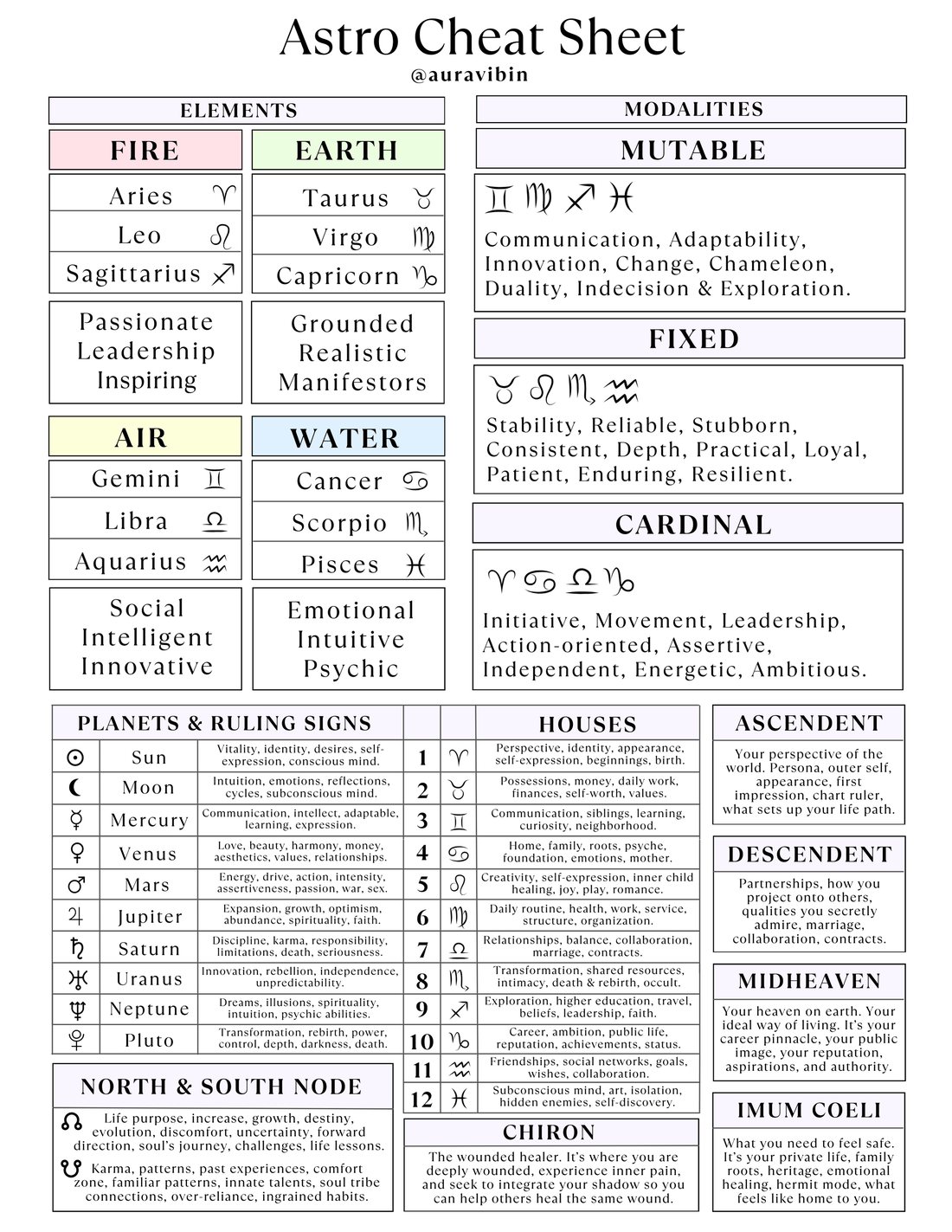
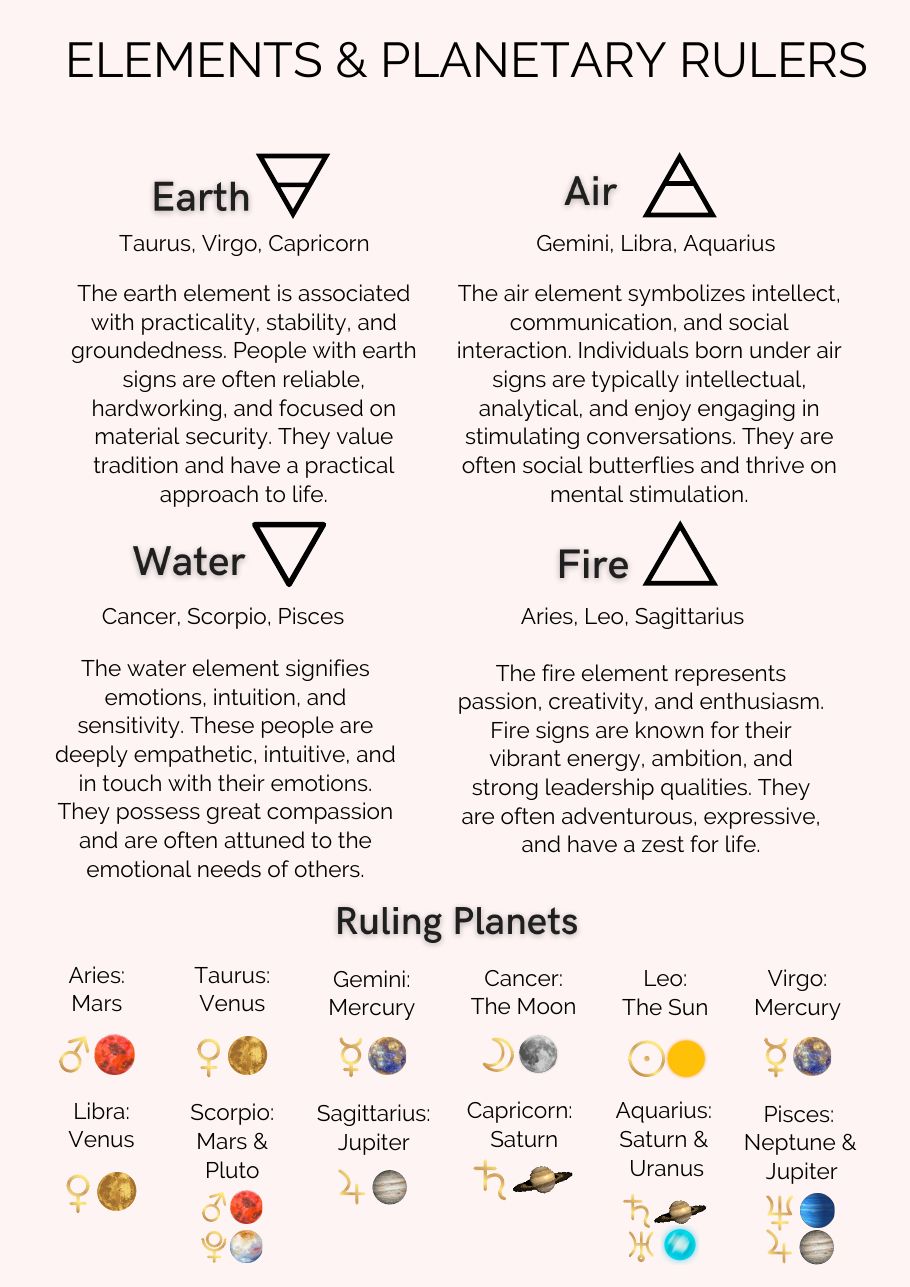
Elements
↓Fire
Passionate, leadership, inspiring. Identity, action, self-expression.
Earth
Grounded, realistic, manifestors. Body, resources, the material world.
Air
Social, intelligent, innovative. Thought, language, connection.
Water
Emotional, intuitive, psychic. Feeling, memory, the unconscious.
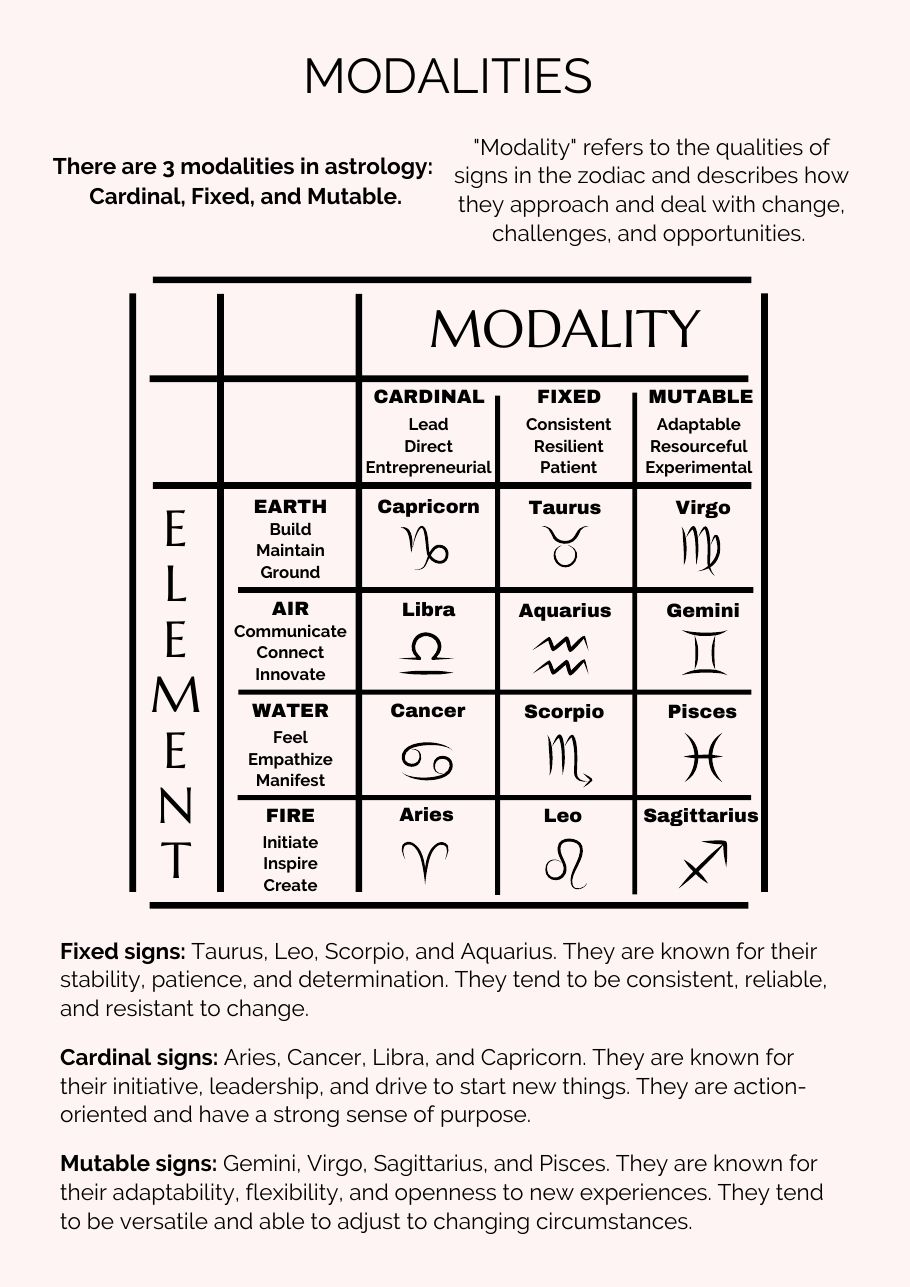
Modalities
↓Cardinal
Initiative, movement, leadership. Action-oriented, assertive, independent, energetic, ambitious. Each one opens a season.
Fixed
Stability, reliability, stubbornness. Consistent, deep, loyal, patient, enduring, resilient. Mid-season anchors.
Mutable
Communication, adaptability, change. Chameleon energy, duality, exploration. Each one closes a season.
Polarity
Fire and air signs are yang — expressive, outward. Earth and water signs are yin — receptive, inward. Traditional texts call these masculine and feminine.
Planets & What They Rule
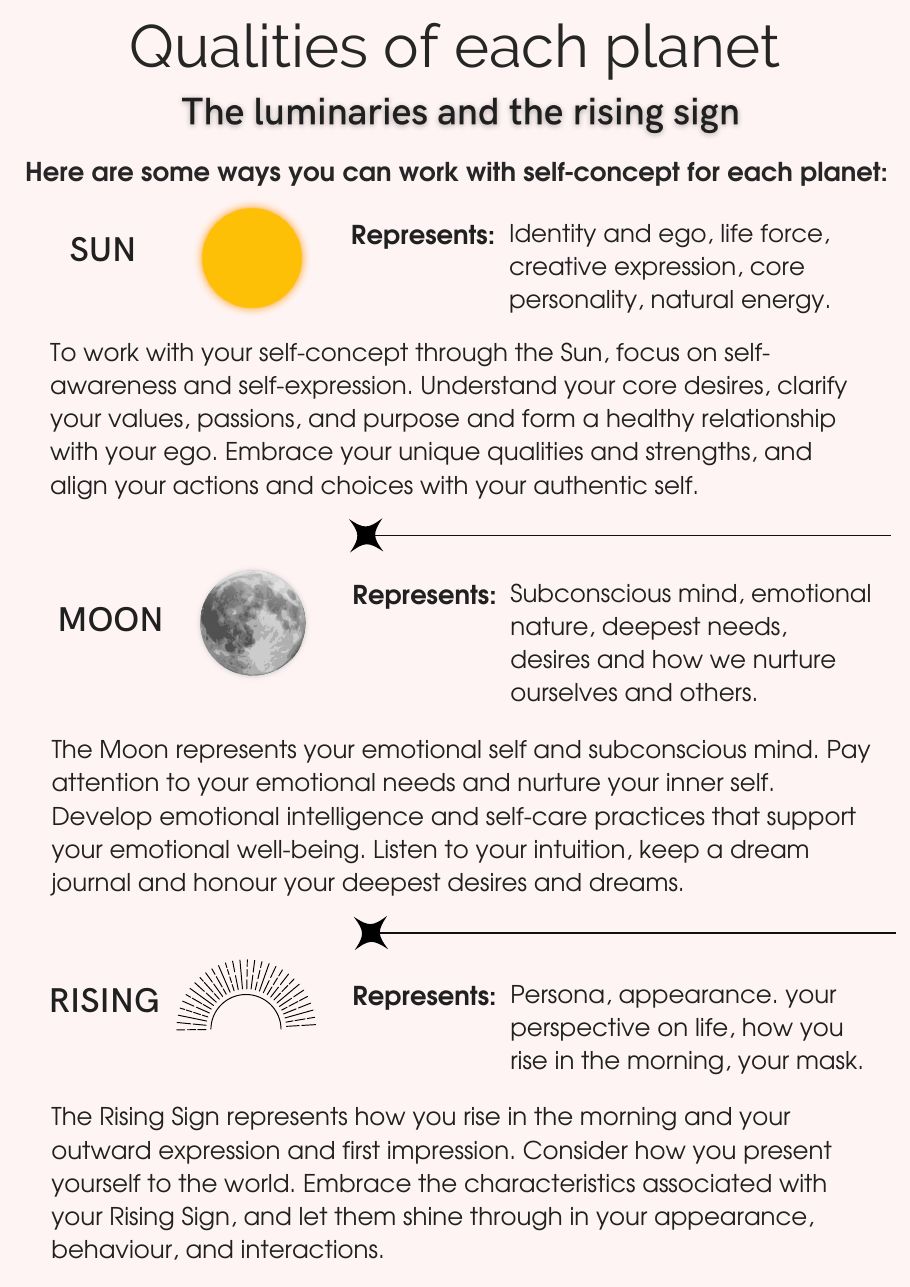
↓| Planet | Rules | Represents |
|---|---|---|
| ☉ Sun | Leo | Vitality, identity, desires, conscious mind |
| ☽ Moon | Cancer | Intuition, emotions, cycles, subconscious mind |
| ☿ Mercury | Gemini, Virgo | Communication, intellect, learning, expression |
| ♀ Venus | Taurus, Libra | Love, beauty, harmony, money, values |
| ♂ Mars | Aries (+ Scorpio trad.) | Energy, drive, action, passion, war, sex |
| ♃ Jupiter | Sagittarius (+ Pisces trad.) | Expansion, growth, optimism, abundance, faith |
| ♄ Saturn | Capricorn (+ Aquarius trad.) | Discipline, karma, responsibility, limits, time |
| ♅ Uranus | Aquarius (modern) | Innovation, rebellion, independence, the unpredictable |
| ♆ Neptune | Pisces (modern) | Dreams, illusions, spirituality, psychic ability |
| ♇ Pluto | Scorpio (modern) | Transformation, rebirth, power, depth, death |
The Houses
↓| House | Themes |
|---|---|
| 1 | Identity, appearance, self-expression, beginnings, birth — the Ascendant |
| 2 | Money, possessions, self-worth, values, income streams |
| 3 | Communication, siblings, learning, the mind, social media, neighborhood |
| 4 | Home, family, roots, the mother, psychological foundation — the IC |
| 5 | Creativity, romance, children, joy, play, inner child healing |
| 6 | Daily routine, health, work, service, habits, pets |
| 7 | Partnerships, marriage, contracts, projection of self — the Descendant |
| 8 | Transformation, shared resources, intimacy, death & rebirth, the occult |
| 9 | Higher learning, travel, beliefs, philosophy, publishing, faith |
| 10 | Career, ambition, public life, reputation, legacy — the Midheaven |
| 11 | Friendships, networks, collective goals, dreams & wishes, the future |
| 12 | Subconscious, isolation, spirituality, karma, hidden things, the womb |
The Four Angles
↓Ascendant
Your perspective of the world. Persona, outer self, appearance, first impression — and its ruler is your chart ruler, setting up the life path.
Descendant
Partnerships, how you project onto others, qualities you secretly admire, marriage, collaboration, contracts.
Midheaven
Your heaven on earth — ideal way of living. Career pinnacle, public image, reputation, aspirations, authority.
Imum Coeli
What you need to feel safe. Private life, family roots, heritage, emotional healing, hermit mode, what feels like home.
Nodes & Chiron
↓☊ North Node
Life purpose, growth, destiny, evolution — the uncomfortable, unfamiliar forward direction of the soul's journey.
☋ South Node
Karma, past patterns, comfort zone, innate talents, soul-tribe connections, over-reliance, ingrained habits.
⚷ Chiron
Where you are deeply wounded, experience inner pain, and seek to integrate your shadow — so you can help others heal the same wound.
Essential Dignities
↓
| Planet | Domicile | Exalted | Detriment | Fall |
|---|---|---|---|---|
| Sun | Leo | Aries | Aquarius | Libra |
| Moon | Cancer | Taurus | Capricorn | Scorpio |
| Mercury | Gemini, Virgo | Virgo | Sagittarius, Pisces | Pisces |
| Venus | Taurus, Libra | Pisces | Aries, Scorpio | Virgo |
| Mars | Aries, Scorpio | Capricorn | Taurus, Libra | Cancer |
| Jupiter | Sagittarius, Pisces | Cancer | Gemini, Virgo | Capricorn |
| Saturn | Capricorn, Aquarius | Libra | Cancer, Leo | Aries |
Domicile = at home, full strength. Exalted = honored guest, elevated. Detriment = opposite its home, compensating. Fall = opposite its exaltation, working uphill. Modern rulers: Uranus in Aquarius, Neptune in Pisces, Pluto in Scorpio (detriments: Leo, Virgo, Taurus).
Degree Meanings
↓Every degree within any sign carries the flavor of one of the twelve signs — the sequence repeats every 12 degrees.
| Degrees | Sign energy | Flavor |
|---|---|---|
| 1, 13, 25 | Aries — Mars | Assertiveness, independence, courage, pioneering |
| 2, 14, 26 | Taurus — Venus | Stability, practicality, material wealth, sensuality |
| 3, 15, 27 | Gemini — Mercury | Communication, adaptability, curiosity, versatility |
| 4, 16, 28 | Cancer — Moon | Nurture, home, emotional depth, protection |
| 5, 17, 29 | Leo — Sun | Creativity, visibility, leadership, the spotlight |
| 6, 18, 30 | Virgo — Mercury | Service, refinement, health, precision |
| 7, 19 | Libra — Venus | Partnership, balance, beauty, diplomacy |
| 8, 20 | Scorpio — Mars/Pluto | Intensity, transformation, power, depth |
| 9, 21 | Sagittarius — Jupiter | Expansion, philosophy, travel, faith |
| 10, 22 | Capricorn — Saturn | Ambition, mastery, structure, public standing |
| 11, 23 | Aquarius — Saturn/Uranus | Innovation, community, rebellion, the future |
| 12, 24 | Pisces — Jupiter/Neptune | Dissolution, spirituality, dreams, endings |
Critical Degrees
| Degrees | Modality | Signature |
|---|---|---|
| 0, 13, 26 | Cardinal — Aries, Cancer, Libra, Capricorn | Where you over-exert yourself |
| 8–9, 21–22 | Fixed — Taurus, Leo, Scorpio, Aquarius | Where you under-exert yourself |
| 4, 17 | Mutable — Gemini, Virgo, Sagittarius, Pisces | Flexibility toward action |
| 29 — anaretic | Any sign | Urgency, mastery, or crisis around that sign's themes |
The Four Quadrants
↓
Q1 — Houses 1–3
Birth, identity, resources, voice. Learning who you are.
Q2 — Houses 4–6
Home, creativity, daily life. Rooting the self into the world around you.
Q3 — Houses 7–9
Partnership, intimacy, belief. Meeting what is not you.
Q4 — Houses 10–12
Career, community, transcendence. Giving the self back to the collective.
To Be · To Have · To Know
↓Angular Houses — To Be
Forward-moving, action-based catalysts for change — your basic needs and foundations. Planets here make you driven and self-motivated.
1st to be independent · 4th to be dependable to family · 7th to be dependent on your partner · 10th to be dependable to society
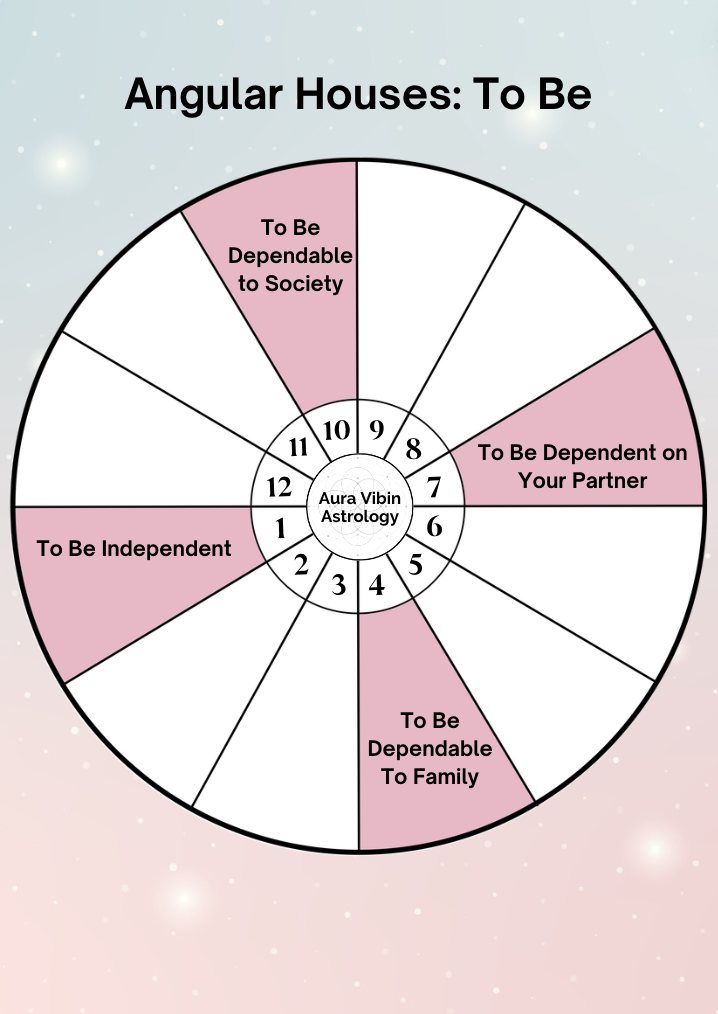
Succedent Houses — To Have
Fixed angles — pausing, getting comfortable with your values and self-worth, building wealth and community. Planets here can take a while to get moving, but once they do, they're VERY confident.
2nd to have for self · 5th to have fun for creative expression · 8th to have connections for resources · 11th to have social networks for impact
Cadent Houses — To Know
From the Latin cado, to decline — falling away from the strength of the angles. Planets here bring many changes and transformations, since these houses are ruled by mutable signs.
3rd to know thyself · 6th to know the body and serve physically · 9th to know philosophies and connect the world · 12th to know others and serve spiritually
The Cheat Sheet Library
The full Aura Vibin graphic collection — tap any topic to open its sheet.
Planetary hours
↓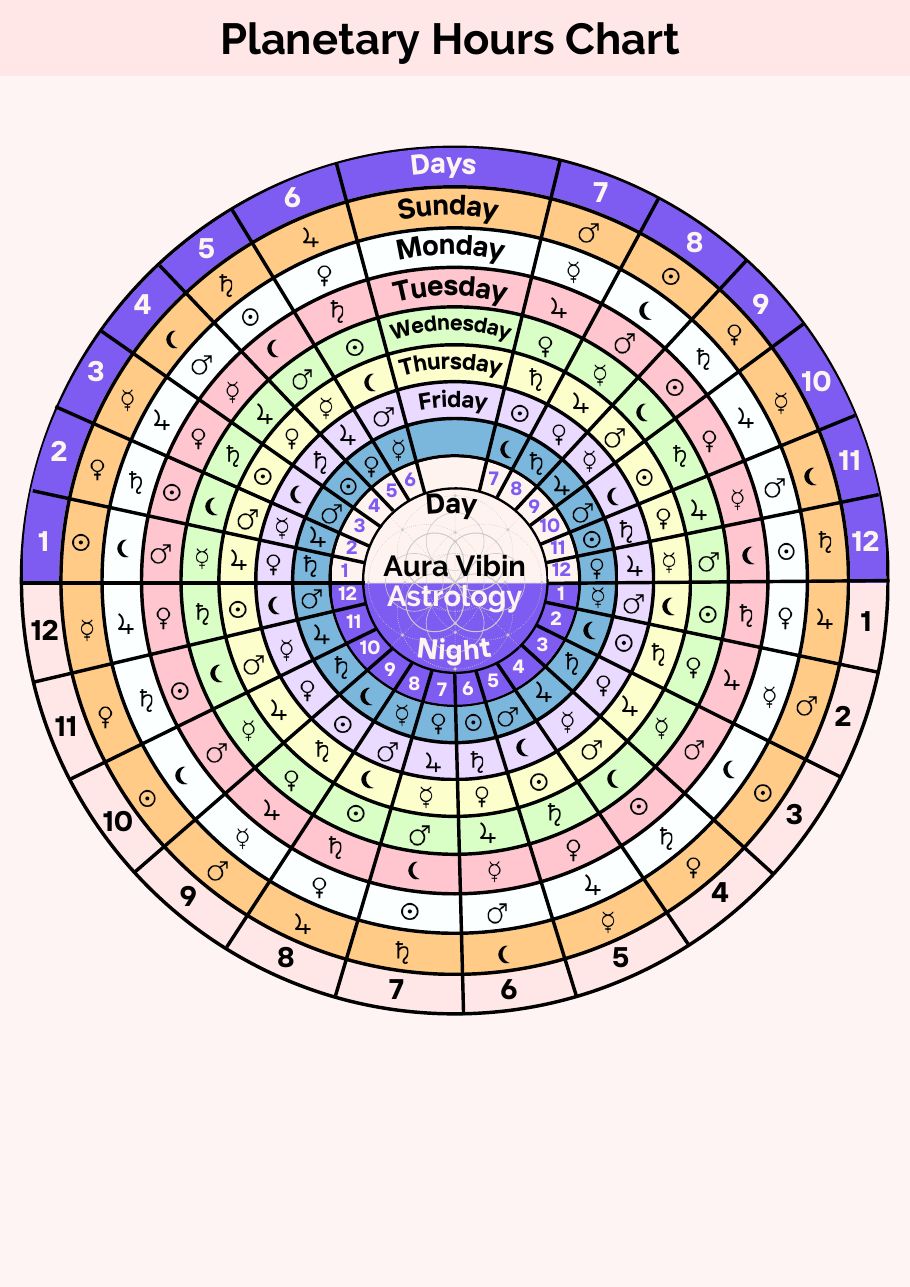
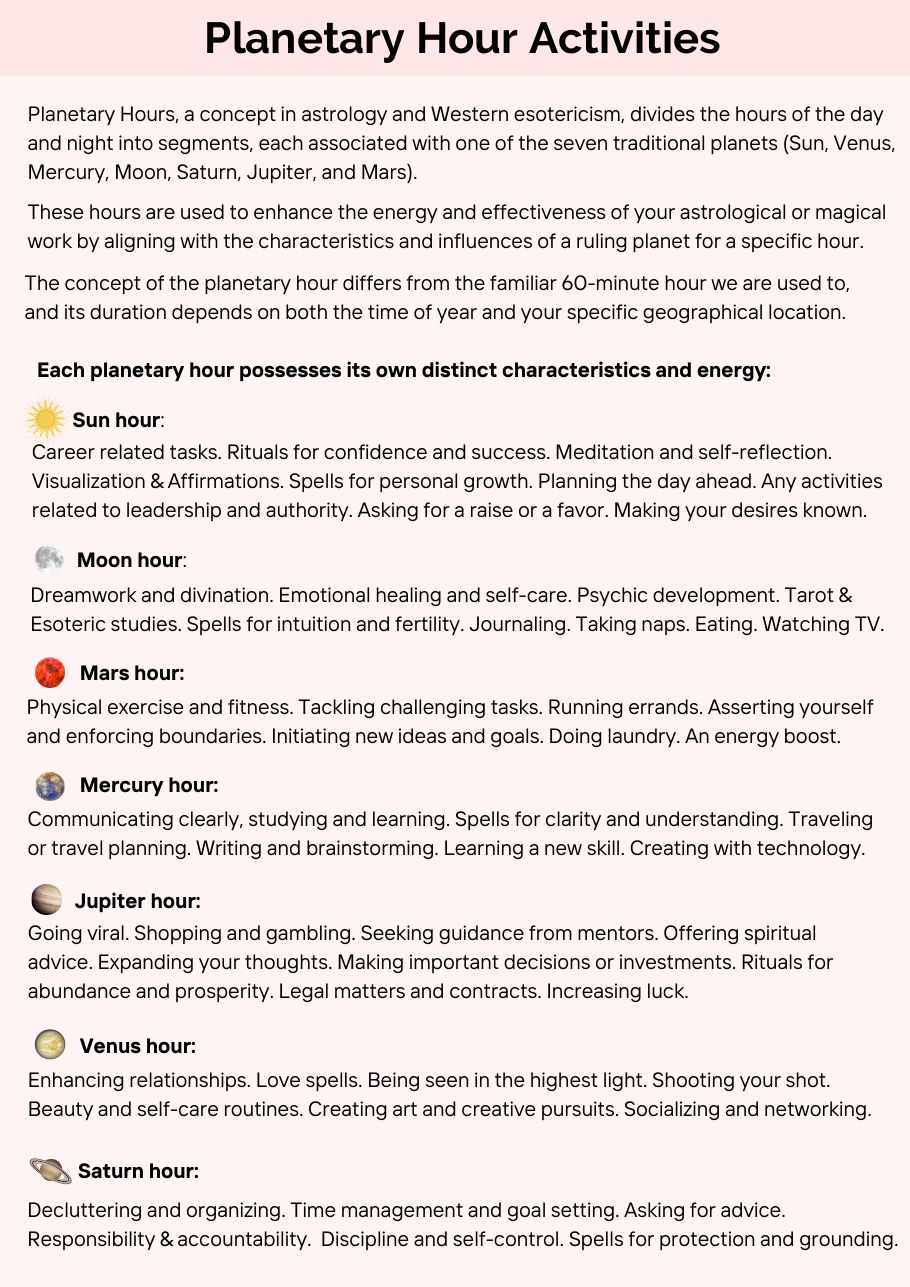
| Day's first hour | The day it names |
|---|---|
| Saturn | Saturday |
| Sun | Sunday |
| Moon | Monday — lundi |
| Mars | Tuesday — mardi |
| Mercury | Wednesday — mercredi |
| Jupiter | Thursday — jeudi |
| Venus | Friday — vendredi |
Modalities grid
↓
Elements & planetary rulers
↓
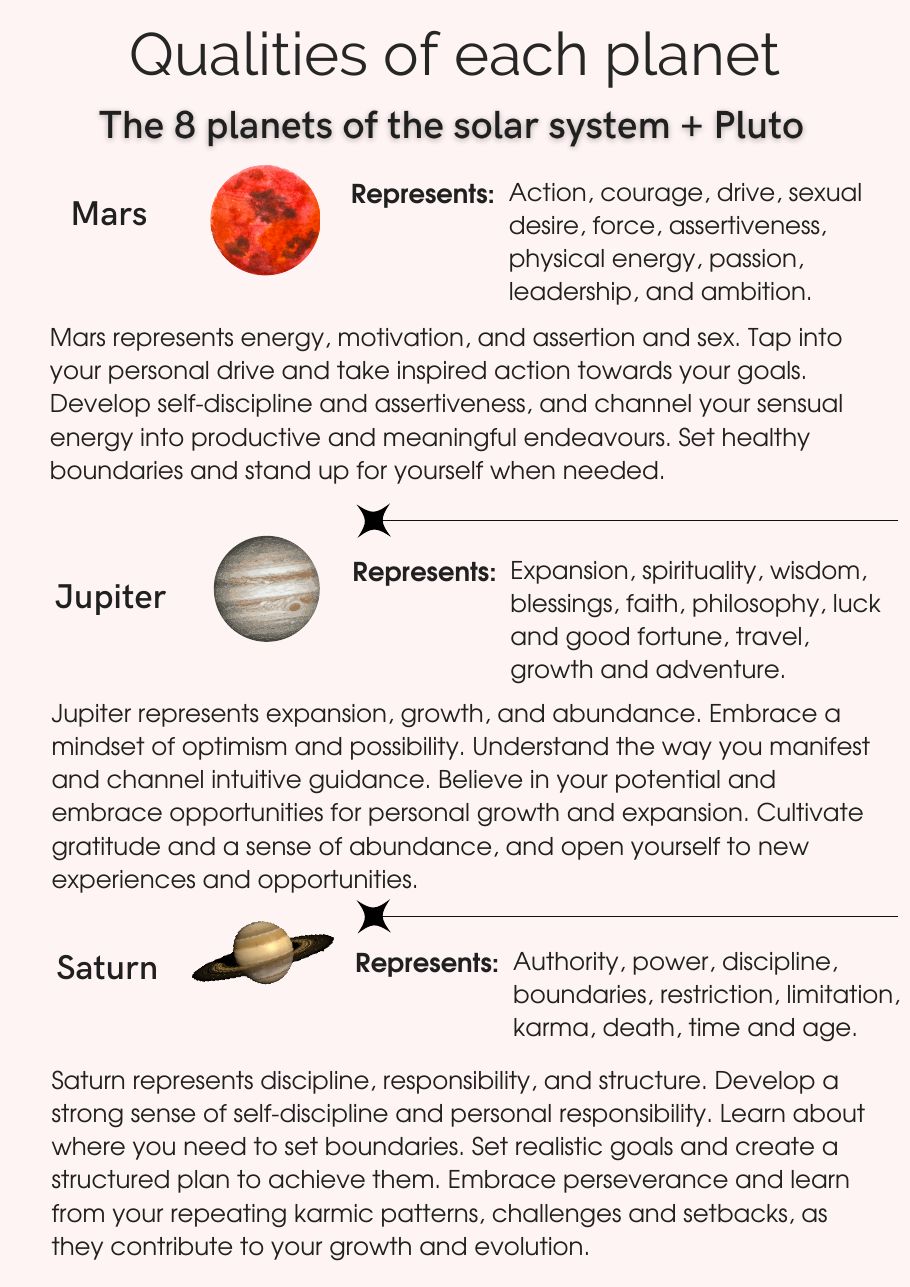
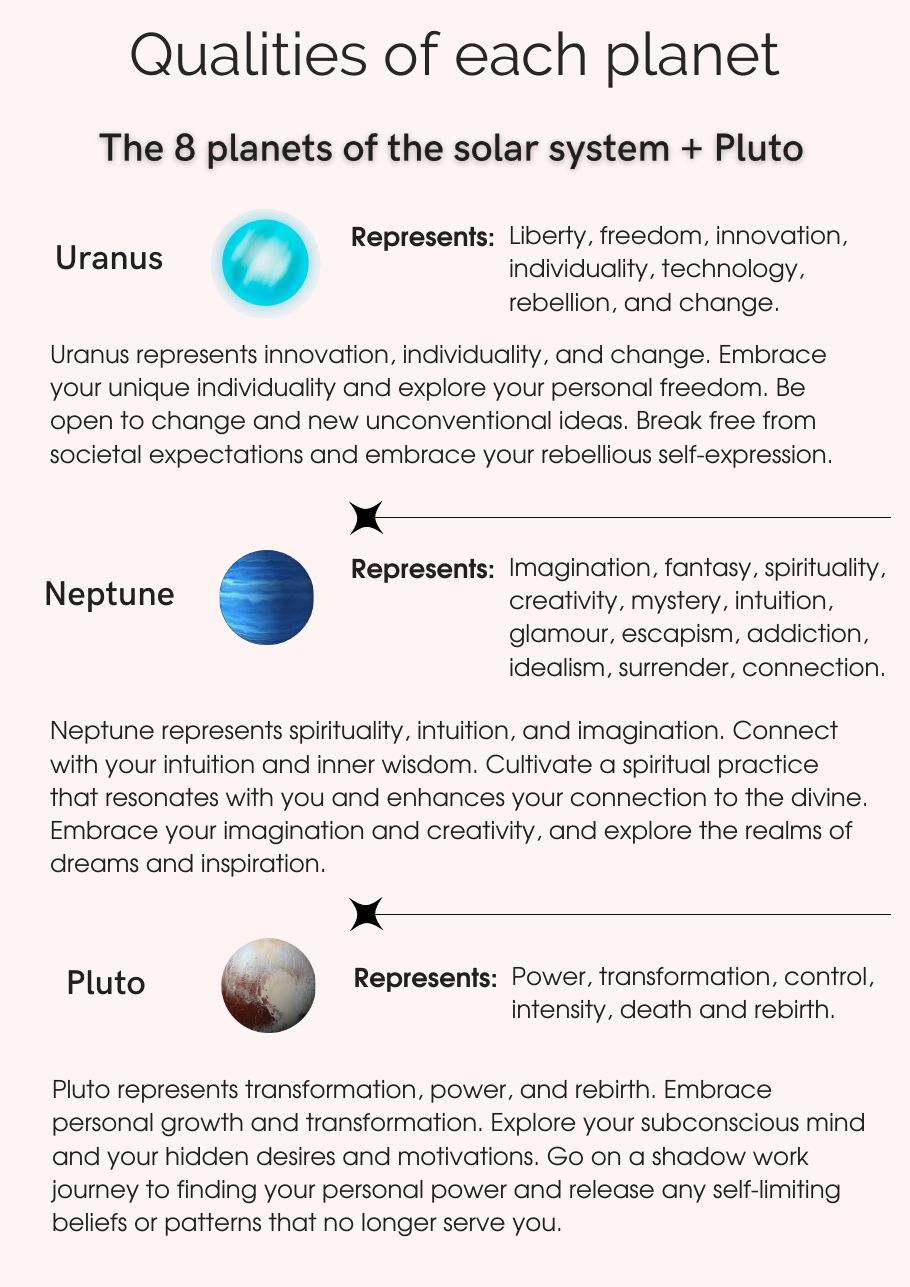
Qualities of each planet
↓
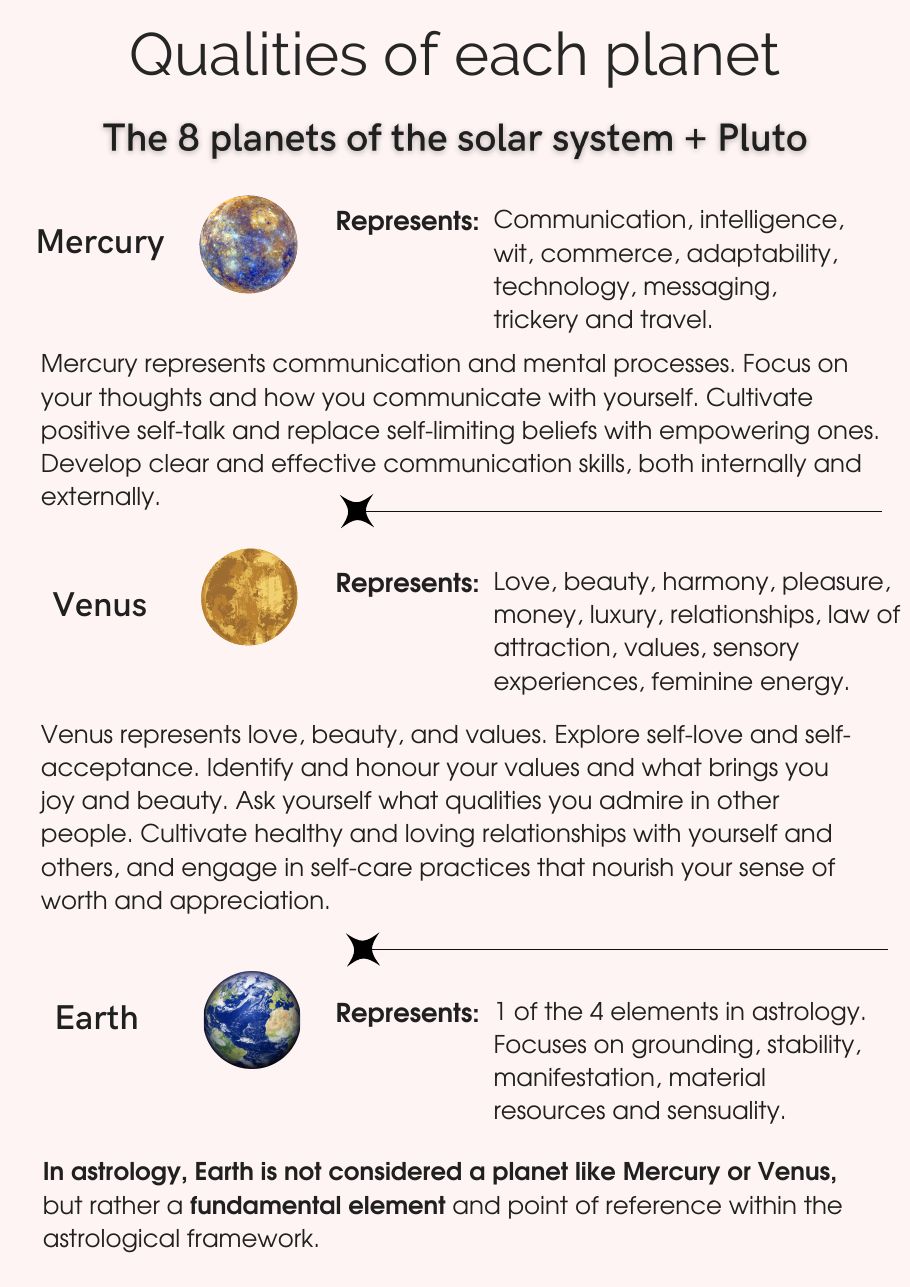
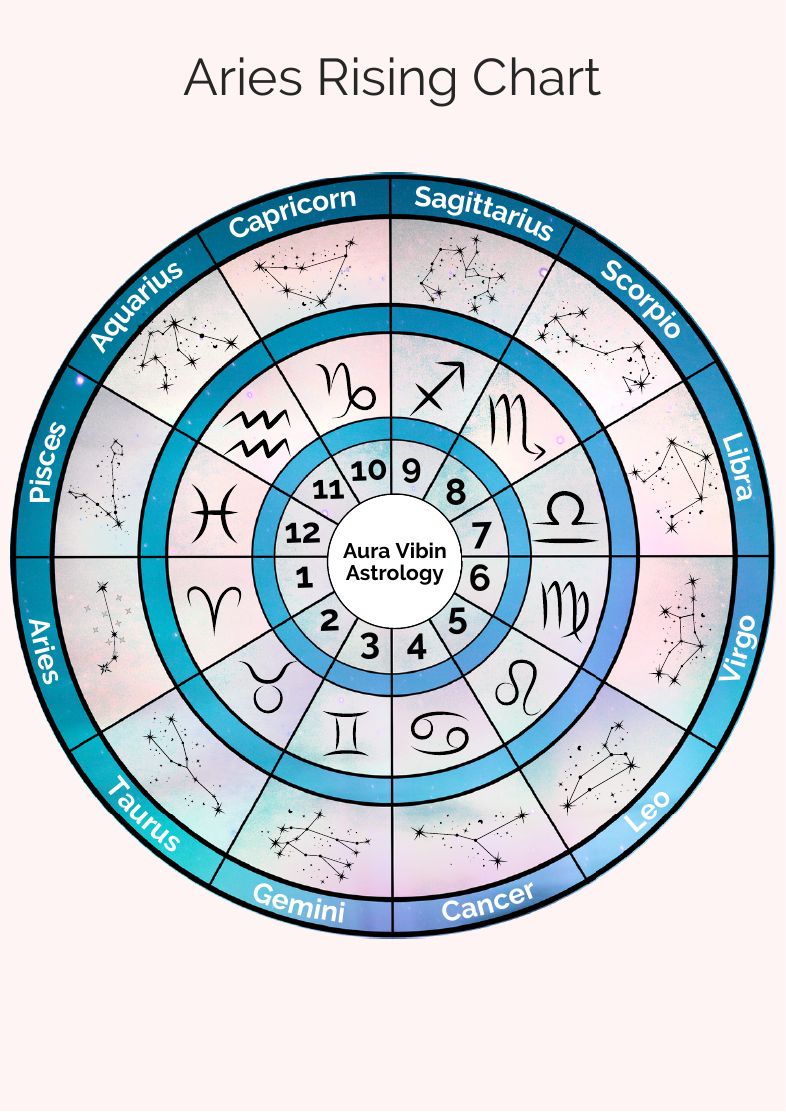
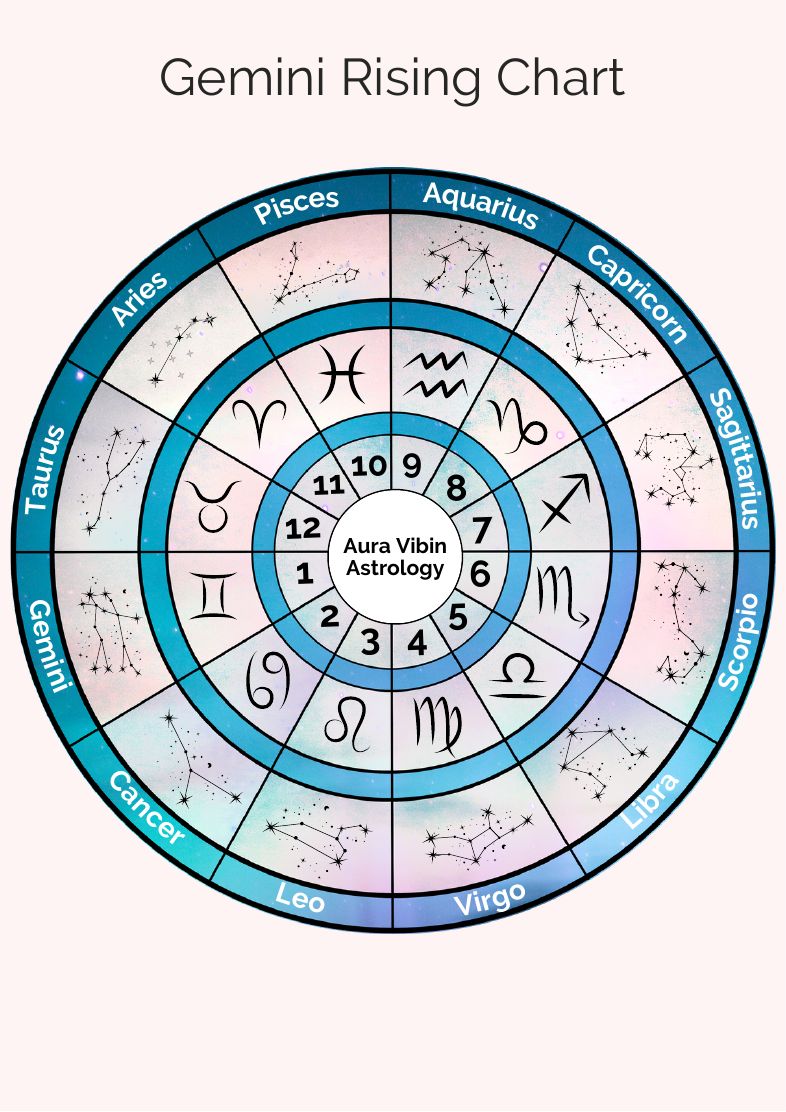
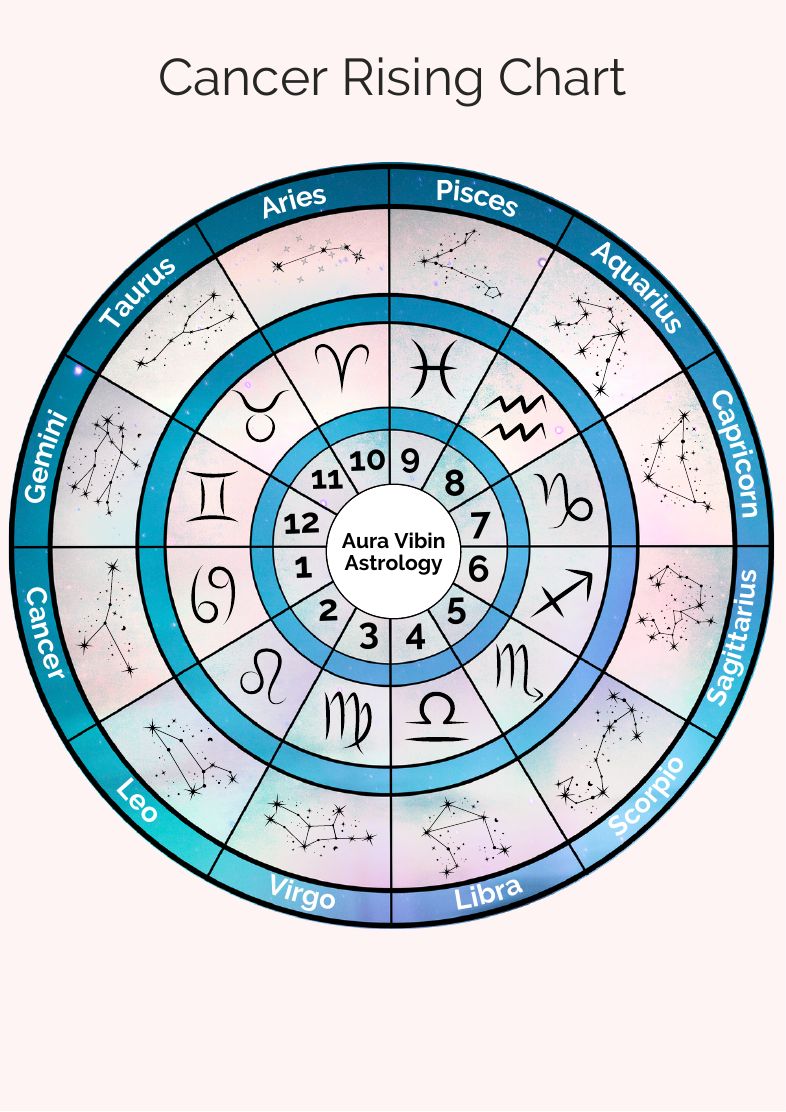
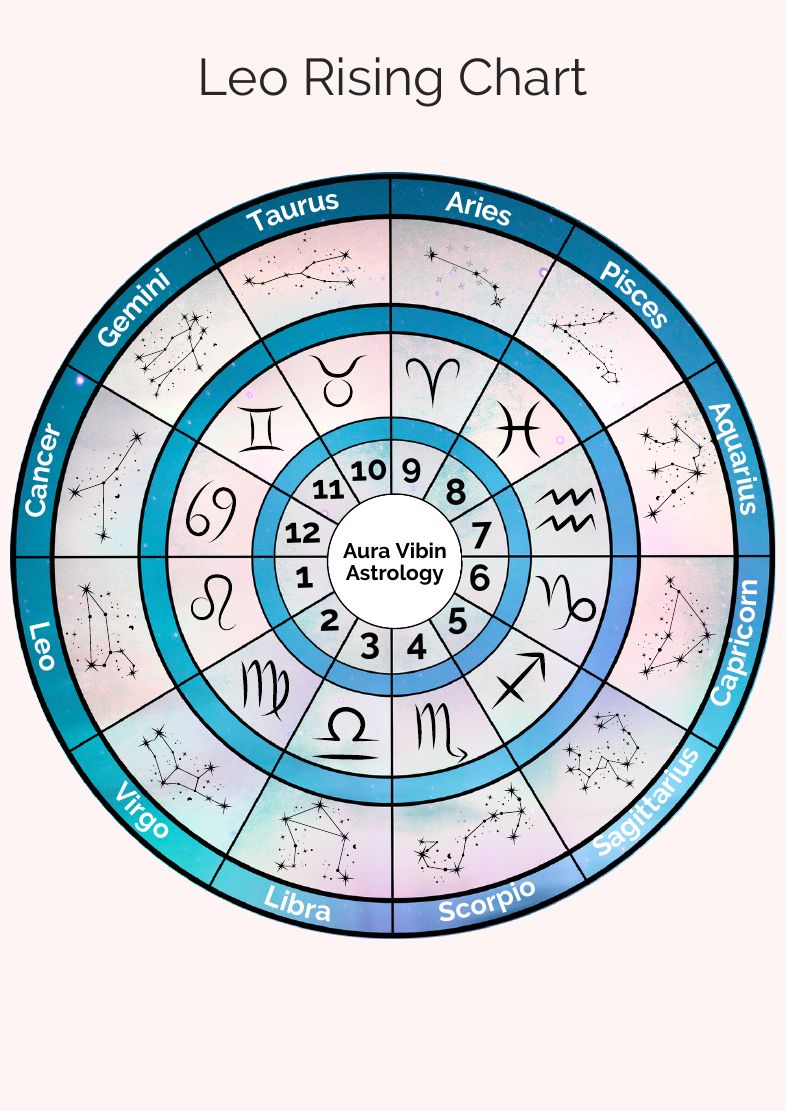
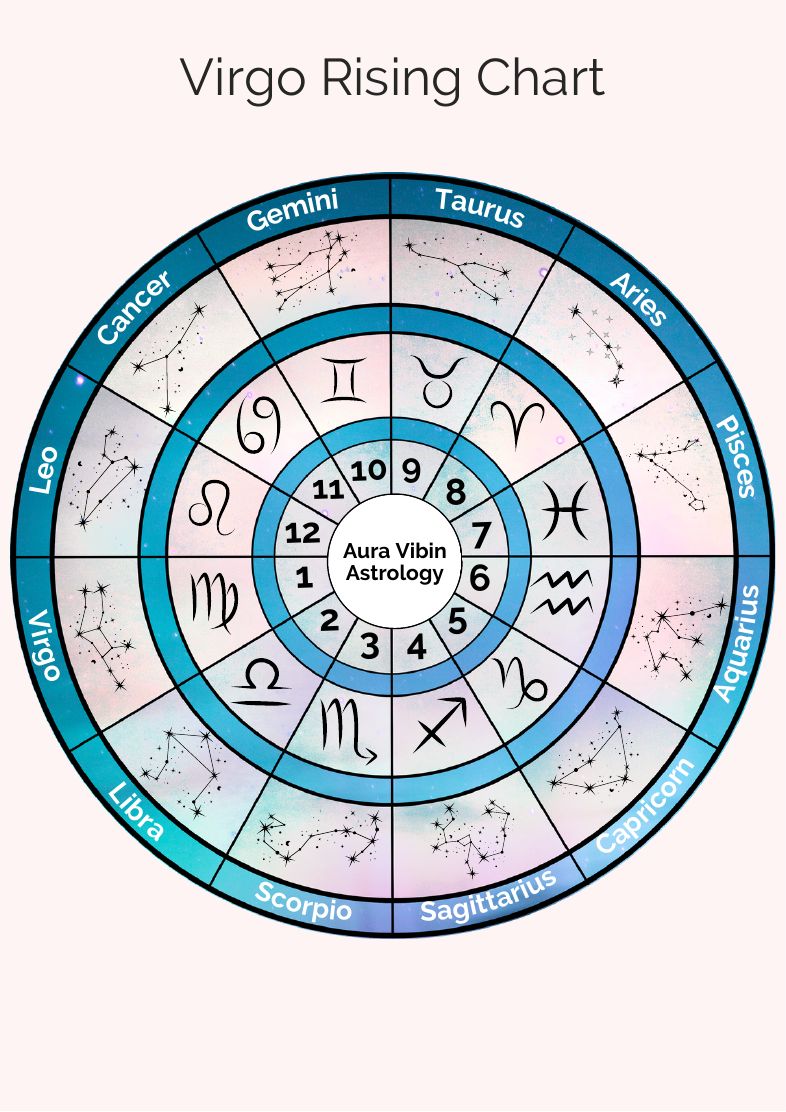
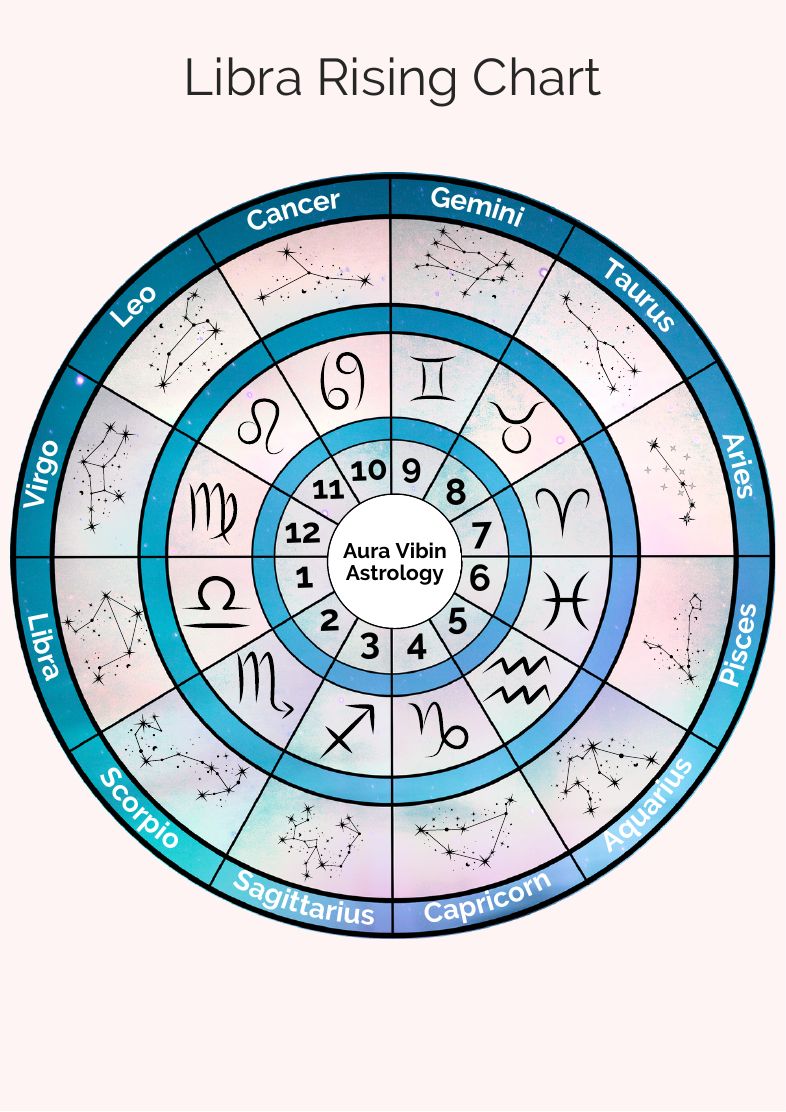
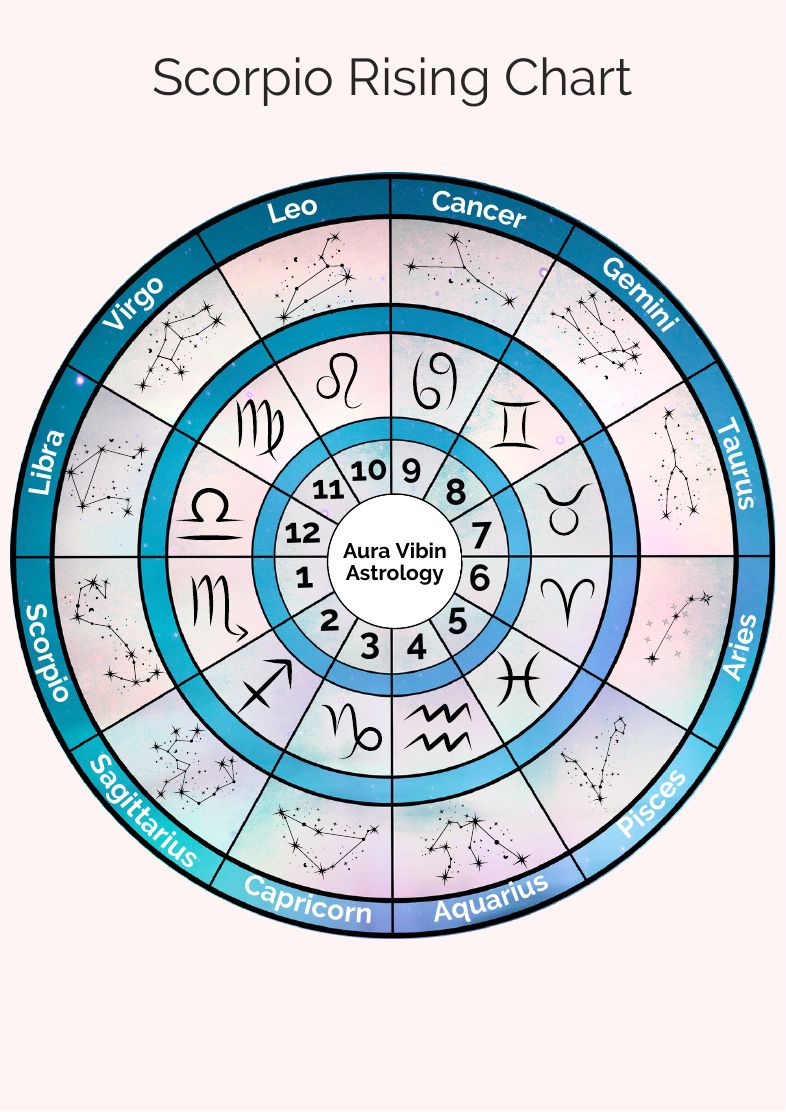
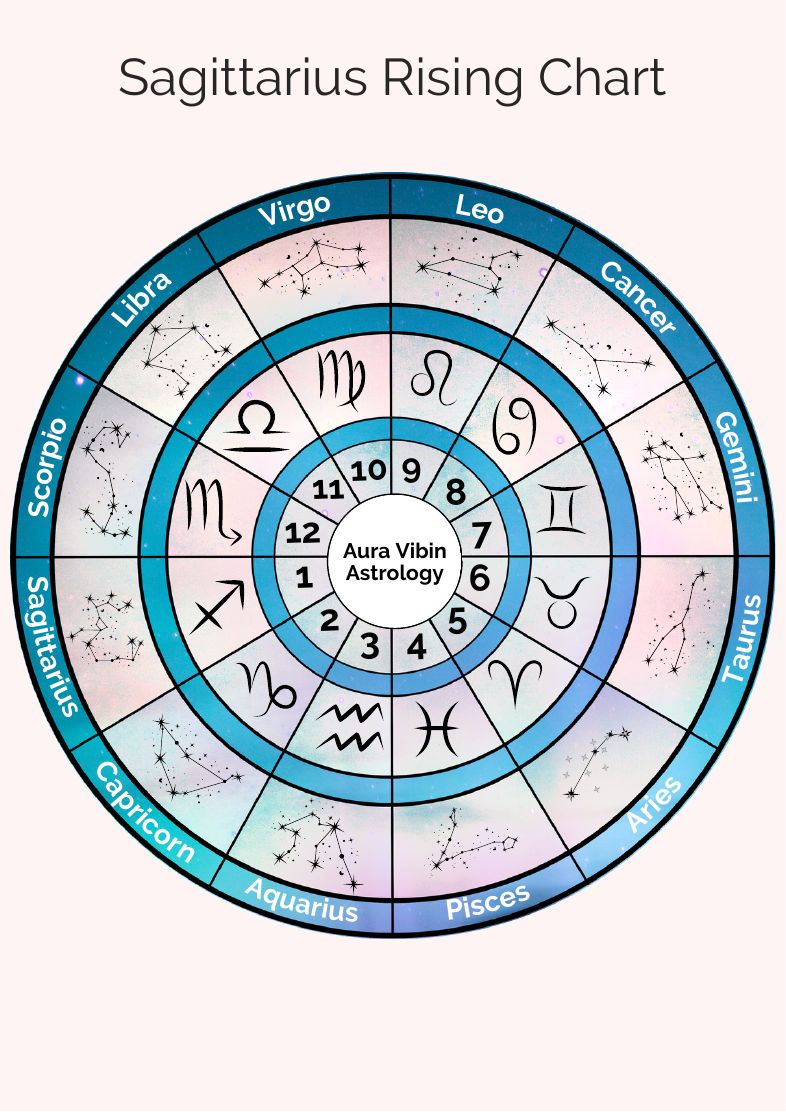
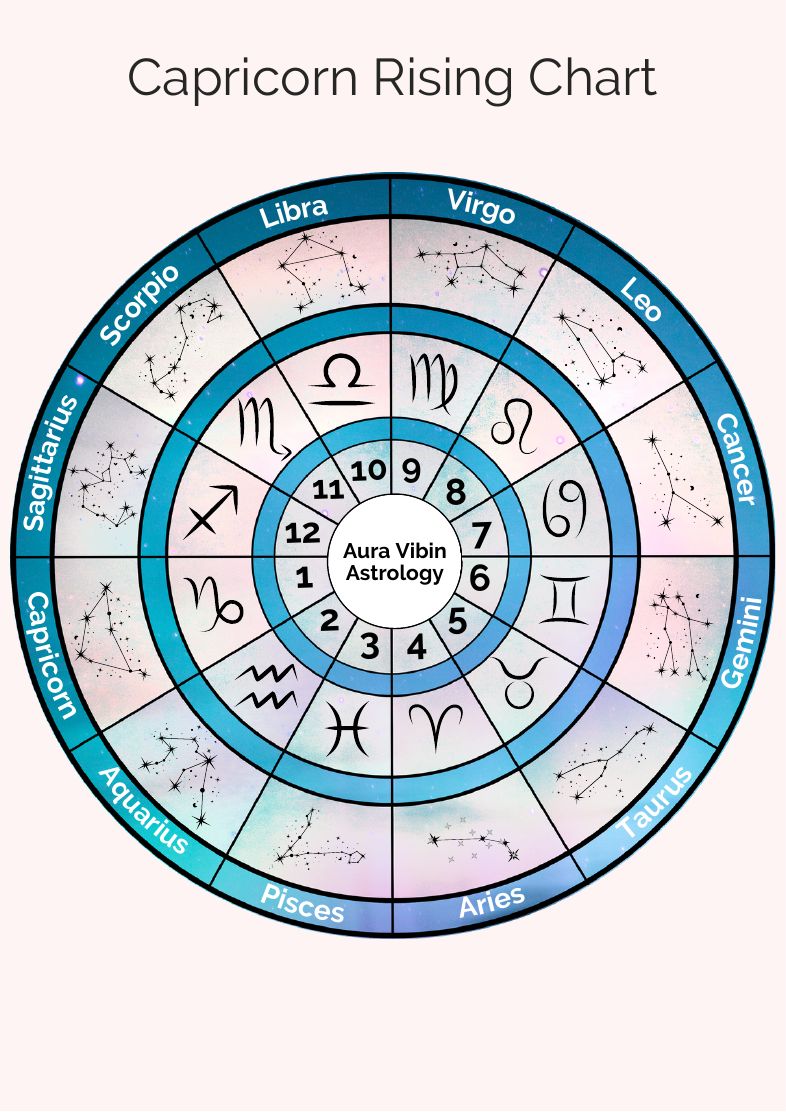
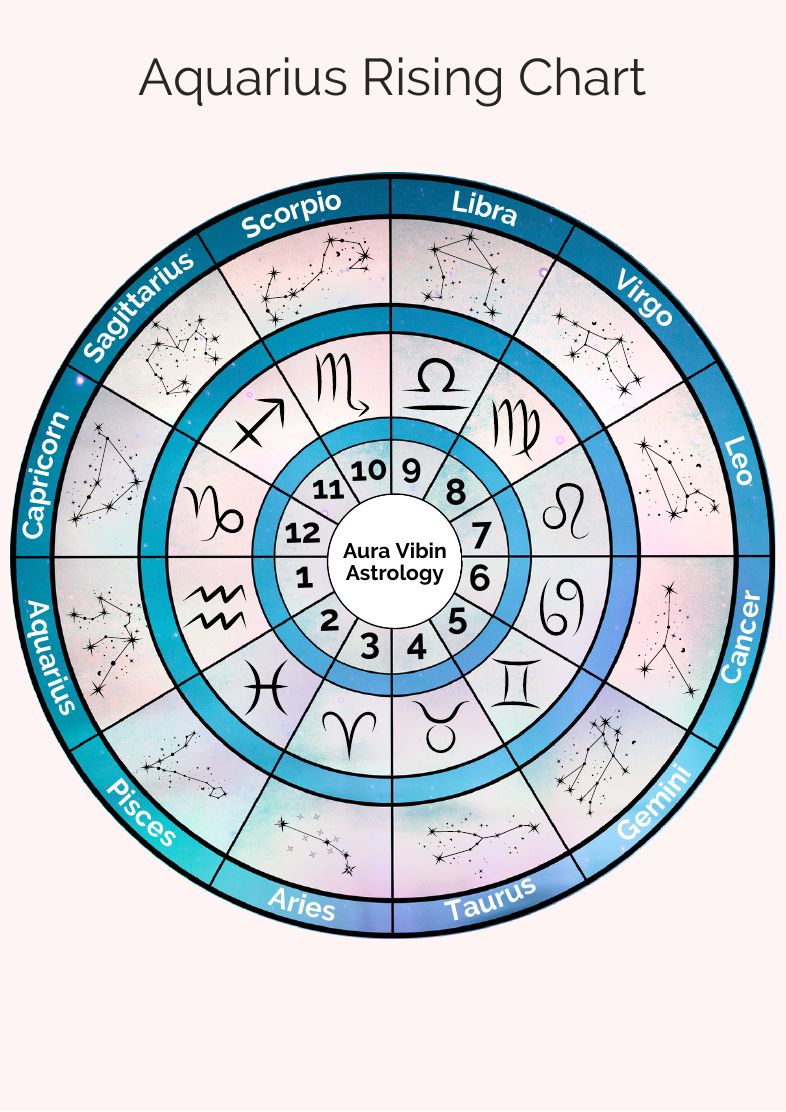
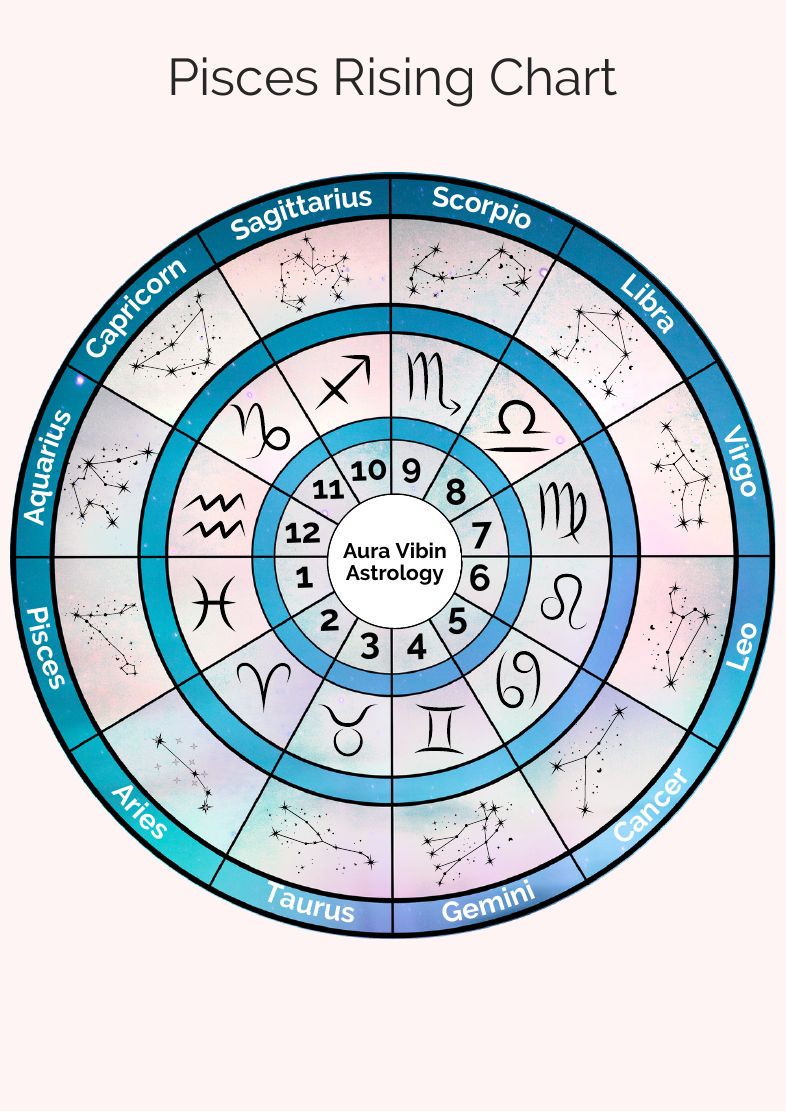
Rising sign charts — whole sign houses
↓
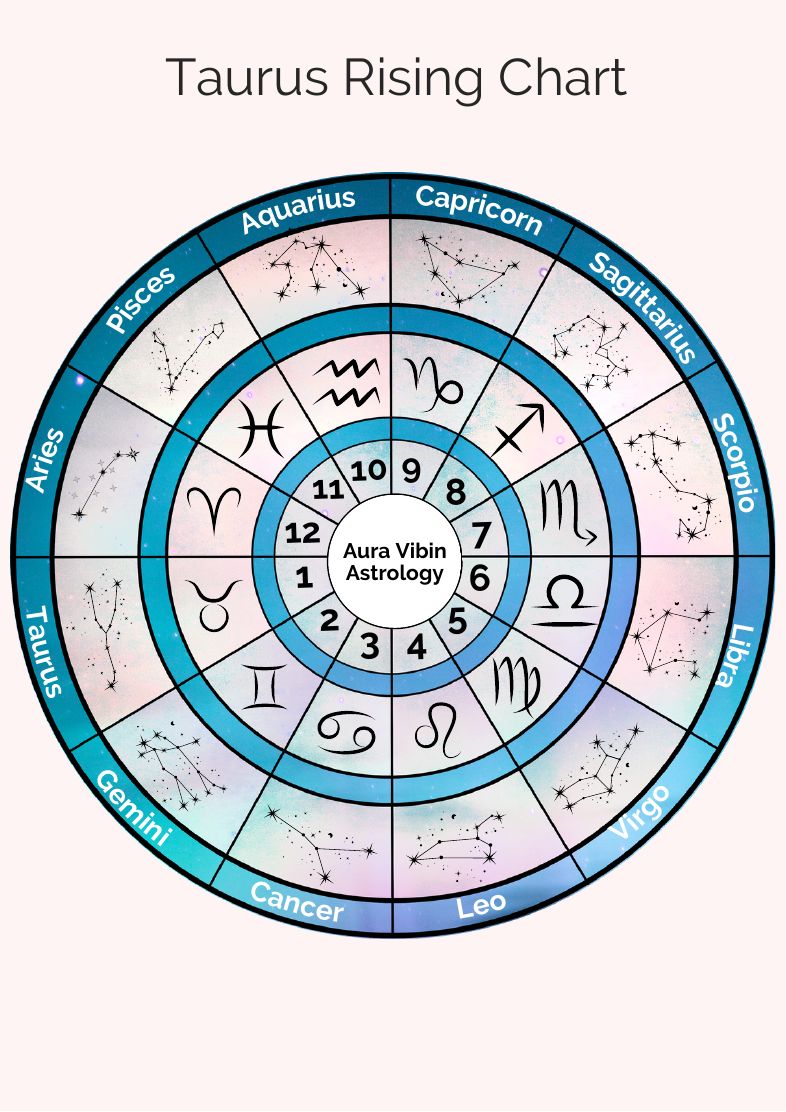
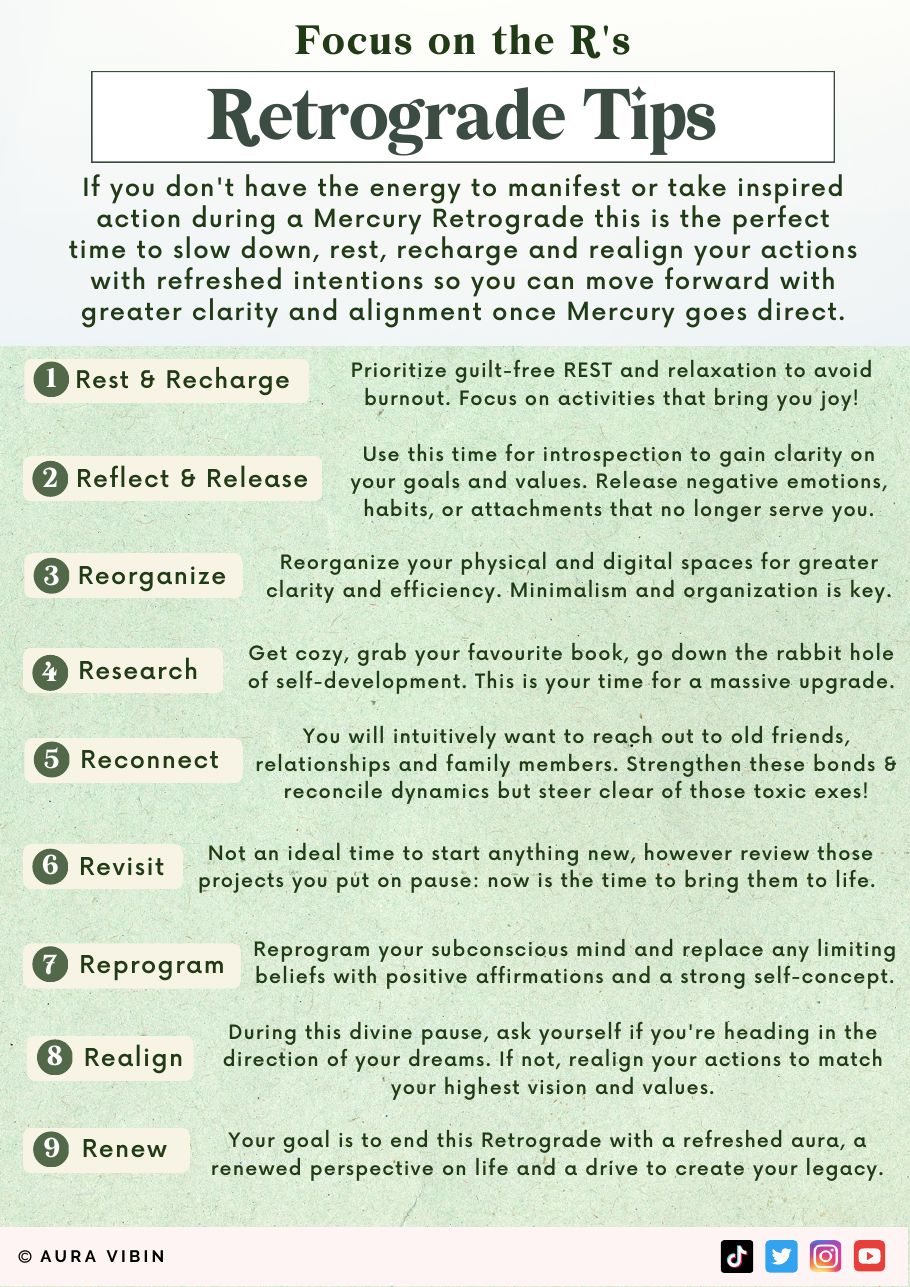
Retrograde tips — focus on the R's
↓
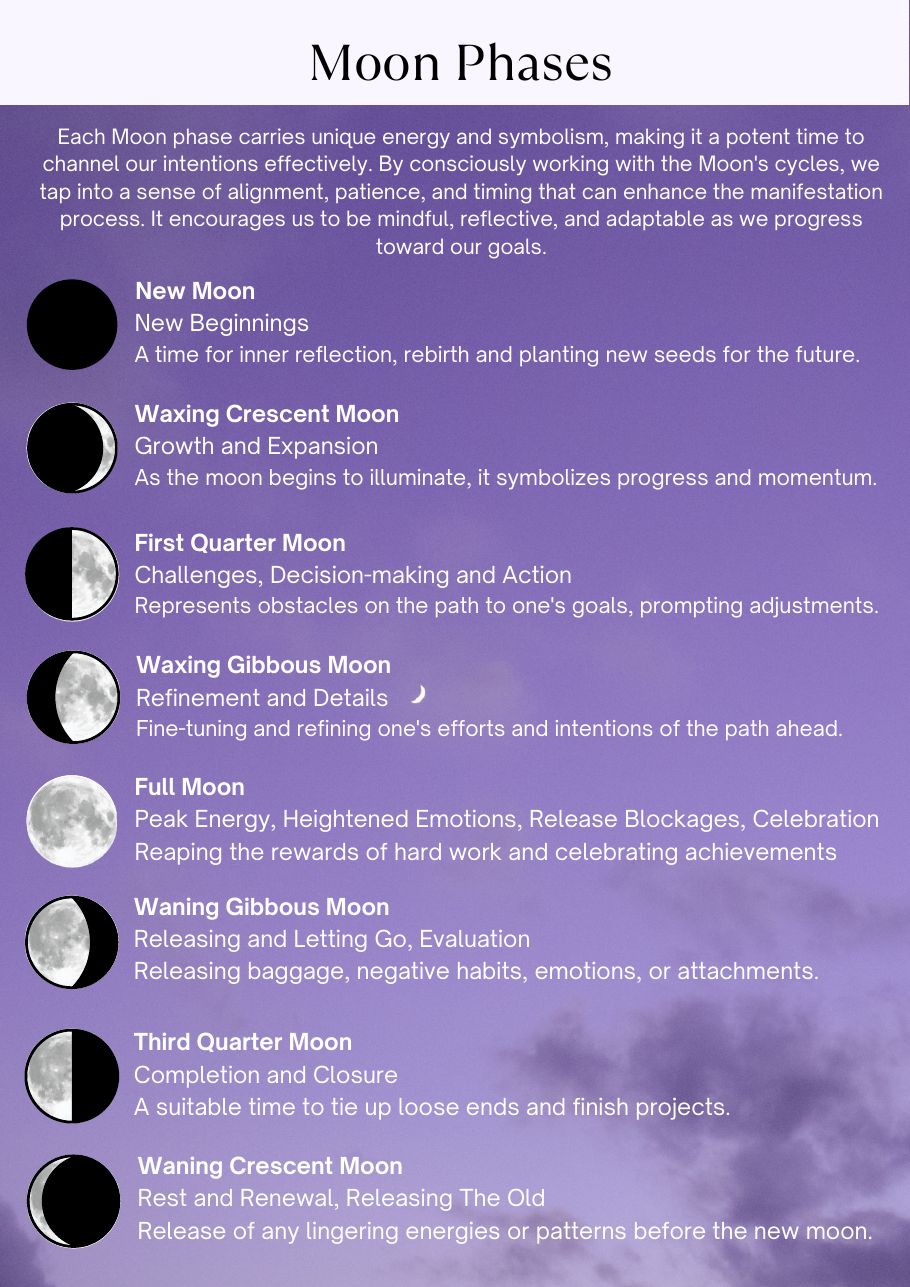
Moon phases
↓
Glossary
The full working vocabulary of astrology — one clean line per term. Star anything to save it into your Study Space.
Pattern Library
A growing archive of real placements matched to real life events — submitted by the community, reviewed before publishing, and tagged so you can research by whatever you're curious about. Filter by planet, house, aspect, or strength of evidence to find the patterns that matter to you.
Loading...
Add to the record
Every chart that gets shared makes the pattern clearer for the next person. Nothing is published without review, and your name is never attached unless you ask for it.
What happened?
My Notes
Your private corner of the site. Everything here lives only in your browser on this device — it never gets sent anywhere. Nobody else can see it, including Aura Vibin. It's yours alone.
How do backups work?
↓The backup file is for extra safety, or syncing without an account. Here's exactly how it works:
To save a backup: tap Export a backup file. A small file (ending in .json) downloads to your device — on a phone it lands in your Files app (usually a "Downloads" folder); on a computer, your Downloads folder. That one file holds all your notes, charts, saved terms, and logs. Keep it somewhere safe — email it to yourself, put it in your cloud drive, or just leave it in Downloads.
To restore it (on a new phone, or after reinstalling): open this site, come to this Notes tab, tap Import a backup, and choose that .json file. Everything comes back exactly as it was.
Think of the backup file like a photo of your notes — you can keep it anywhere, and load it back in whenever you need it.
A private space for any images you want to keep — screenshots, chart wheels, diagrams, anything. Give each a title and an optional category. Tap an image to zoom.
Nothing saved yet — star glossary terms to collect them here.
Your private chart archive. Save the birth data of everyone in your life, attach their chart image, and log the events that actually happened to them. This is how pattern recognition is built.
Test yourself — a random term appears, recall the definition, then tap to reveal.
Work with Aura
This whole app is a gift — everything here is free to learn from. If it's opened something in you and you'd like to go deeper, my courses, readings, and offerings live over here.
Explore with Aura ✦auravibin.com
Log every chart you practice on. Watching this list grow is watching yourself become a reader.
Every question you can't answer yet is a future strength. Collect them here and check them off as you learn.
Let's help you glow
Your daily check-in with the sky. What today holds, how the energy moves through the week and month, and space to track your own rhythm alongside it.
Tap any day to log how you felt, or to see the sky for that day. All times Eastern (ET). Every logged day is yours forever.
2026 · Year at a glance
↓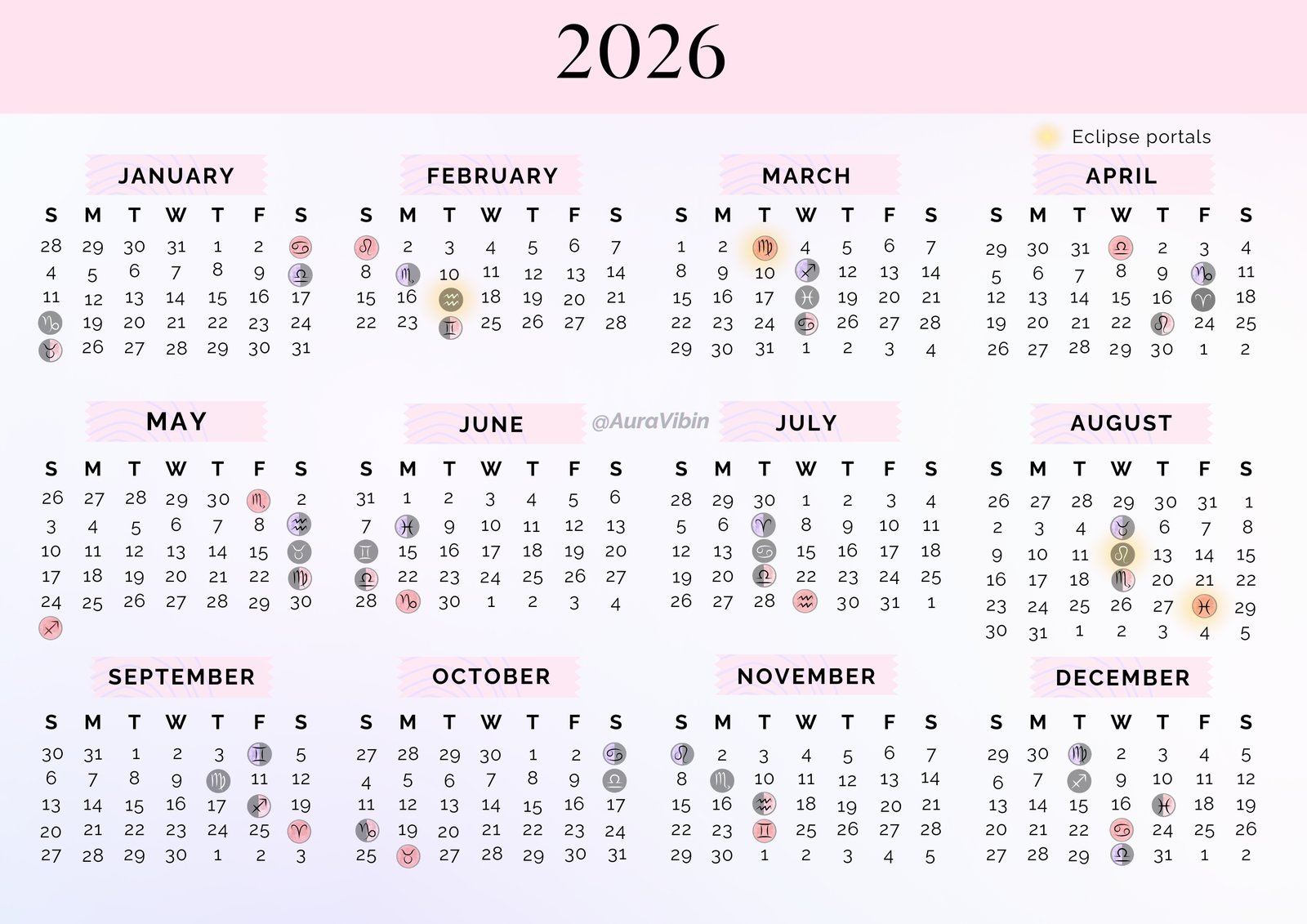
Sync across devices
Optional. Everything on this site works without an account — this is only if you'd like your notes and charts on more than one device, or safely backed up.
You don't need an account to use anything here. Create one only if you want your notes and charts on more than one device, or backed up in case you lose your phone.
What gets stored, and your rights
Only your email address and whatever you choose to save in this Notes tab — study notes, saved terms, charts you add, and their images. Nothing else. Your data is stored on Supabase servers and is readable only by your own account; nobody else can access it, including Aura Vibin. It is never sold, shared, or used for advertising. You can export a copy or permanently delete everything at any time using the buttons here. Birth data you enter about other people should only be added with their knowledge.
Me
Your birth details, kept private on your device. This is the home for your own chart — with your placements, and readings in Aura's voice, coming as the next chapter of Solstere.
Stored privately on your device (and synced to your account if you have one). You can edit anytime.